Habitat
 Depth
 Group
 Role
 Size
 Good to know
WHAT DOES IT LOOK LIKE?
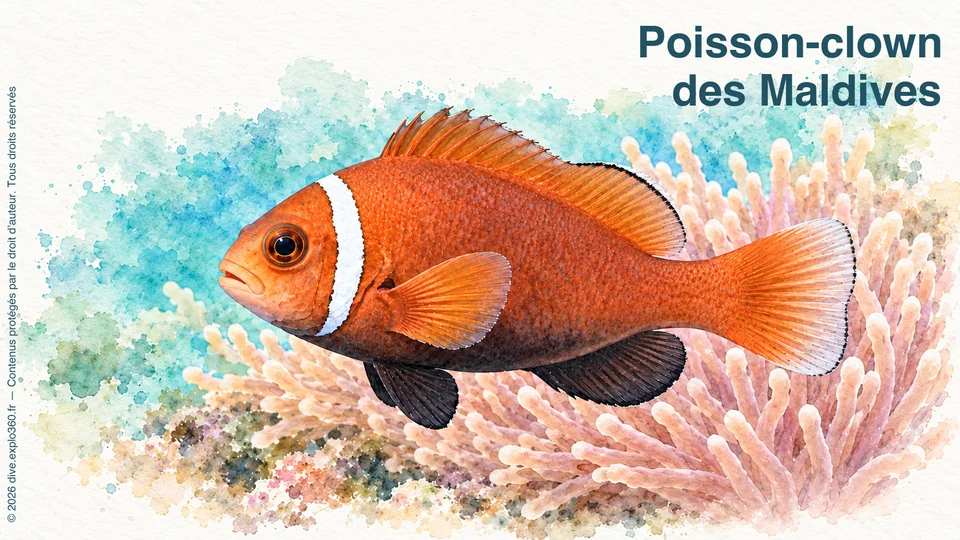
The black belly and lower fins contrast with the orange to orangey brown of the Maldive anemonefish (Amphiprion nigripes). A single white band crosses the body behind the head.
The pelvic fins beneath the front body and the anal fin beneath the rear remain dark. The number of bands and this distribution of black describe the fish more precisely than orange alone.
WHERE DOES IT LIVE?
This clownfish inhabits a relatively small part of the Indian Ocean around the Maldives, Sri Lanka and the Lakshadweep islands. Its presence on a reef is linked to the magnificent sea anemone. It stays among the tentacles of this host, the animal that shelters it, and in the water immediately around it. During a dive, finding the anemones is therefore more useful than expecting the fish everywhere between the corals. Several fish may share one refuge without forming a shoal that travels around the reef.
WHAT DOES IT EAT?
Small waterborne crustaceans provide part of the Maldive anemonefish’s food. Copepods and shrimp larvae are among the reported items, alongside algae. It takes animal food from plankton while also consuming algal material. Foraging occurs near its anemone, where passing food particles are accessible. Its natural diet is less precisely quantified than that of some other anemonefishes, and no fixed division between algae and animal prey has been established here.
GO FURTHER WITH AMIGANSEAU
Unlock the full profile
Deepen your knowledge with the exclusive chapters and interactive resources included in an AMIGANSEAU licence.
- HOW DOES IT REPRODUCE?
- OUR OBSERVATIONS
- ARTICLE
Also included in the full profile
- Advanced navigation between description, ecological context, observations and behaviour
- Interactive food chain to explore the species’ feeding relationships
- Infographic and illustrated summary profile
 Understand the species