Partners and information

Contact us

Verification code

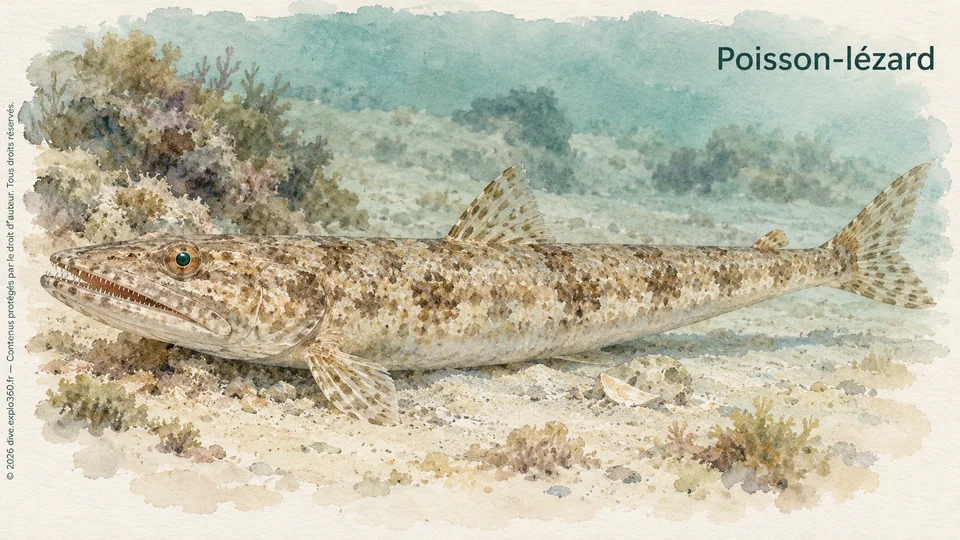
Atlantic lizardfish

Distribution : Mediterranean and subtropical eastern and western Atlantic. In France, sightings include Marseille, Côte Bleue, Antibes and Cagnes-sur-Mer, often on shallow sandy bottoms.

The lizardfish’s flat head blends into the sand. Its eyes sit on top, watching the water where prey may pass. You may see them before you make out its mouth.

Images being acquired · Your video or photos here

Habitat of Atlantic lizardfish Habitat
Sand
Depth range of Atlantic lizardfish Depth
1-400 m
Biological group of Atlantic lizardfish Group
Ecological role of Atlantic lizardfish Role
Predator

Size

Often 20–40 cm; individuals of 46 cm are described from the Azores

WHAT DOES IT LOOK LIKE?

The Atlantic lizardfish (Synodus saurus) has a flattened head, triangular from above, followed by an almost cylindrical body. Its large mouth extends behind the eyes and shows many fine teeth. A triangular fin rises midway along the back; a small adipose fin, a fleshy fin, lies farther back.

GO FURTHER WITH AMIGANSEAU

Unlock the full profile

Deepen your knowledge with the exclusive chapters and interactive resources included in an AMIGANSEAU licence.

Choose my licence
  • WHERE DOES IT LIVE?
  • WHAT DOES IT EAT?
  • HOW DOES IT REPRODUCE?
  • OUR OBSERVATIONS
  • ARTICLE

Also included in the full profile

  • Advanced navigation between description, ecological context, observations and behaviour
  • Interactive food chain to explore the species’ feeding relationships
An active licence gives access to enriched profiles and AMIGANSEAU exploration tools.
Atlantic lizardfish

Understand the species

What is this species’ ecological role?

AMIGANSEAU Explorer Premium

Access enriched species profiles with advanced content (audio, infographics and detailed articles).

Explore all species easily through a single interface.

Enjoy a smooth, fast learning experience suited to every level.

🔒 The full profile is available with a paid subscription only.

Discover licences

POURSUIVRE L’EXPLORATION

Explore further

ArticleSCHOOLS OF FISHRead the article →ArticleTHE SECRETS OF SANDRead the article →ArticleWHAT IF IT ALL HAPPENED UNDERWATER?Read the article →