 Habitat
 Depth
 Group
 Role
 Size
WHAT DOES IT LOOK LIKE?
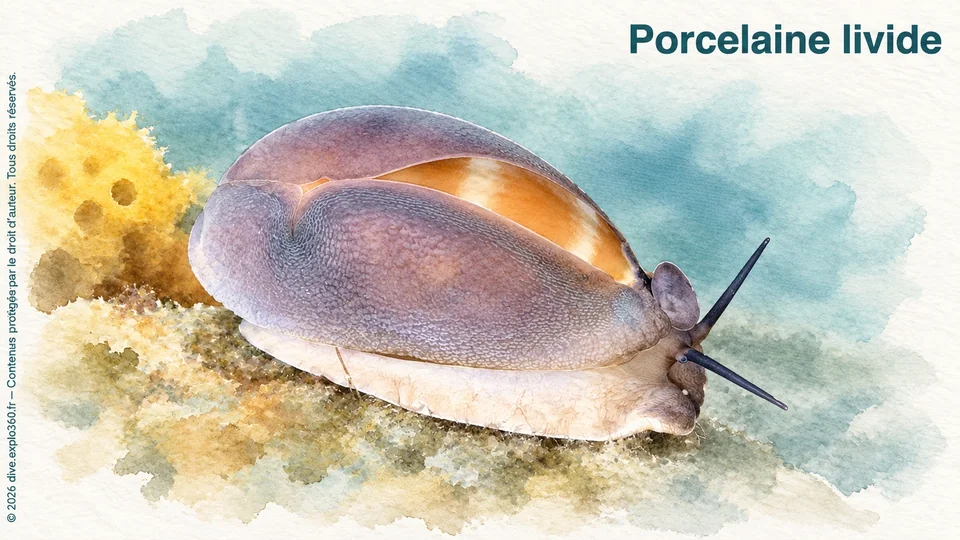
Dark-spotted orange ends finish the shell of the lurid cowrie (Luria lurida). Between them, two pale bands cross a smooth shiny brown to grey-brown surface. The underside slit is long, narrow and edged with little tooth-like ridges. Two mantle lobes, living tissue around the body, may meet above and hide the shell.
WHERE DOES IT LIVE?
It inhabits dim rocky places, cracks and cavities, from shallow water to several tens of metres. It often hides by day and becomes more active at night.
Sponge communities are useful places to search. Its discreet habits should not be mistaken for consistent absence from a site.
WHAT DOES IT EAT?
The lurid cowrie obtains food from sponges. It is notably observed at night on the yellow tube sponge, a frequently consumed resource. Other sponges, including the golf-ball sponge, also enter its diet. Flesh is removed with the feeding apparatus and toothed radula. Ridges along the shell slit do not perform this work: they are mineral denticles. The feeding organ remains within the mouth against sponge tissue.
GO FURTHER WITH AMIGANSEAU
Unlock the full profile
Deepen your knowledge with the exclusive chapters and interactive resources included in an AMIGANSEAU licence.
Subscribing to Dive.Explo360 means supporting a different way to discover marine life.
Our independent platform is entirely self-funded and relies solely on subscriptions. Every licence helps us continue our work, create new content, and share what we know about the marine world with as many people as possible.
Starting at €80 per year, your support makes all the difference.
 Understand the species