Habitat
 Depth
 Group
 Role
WHAT DOES IT LOOK LIKE?
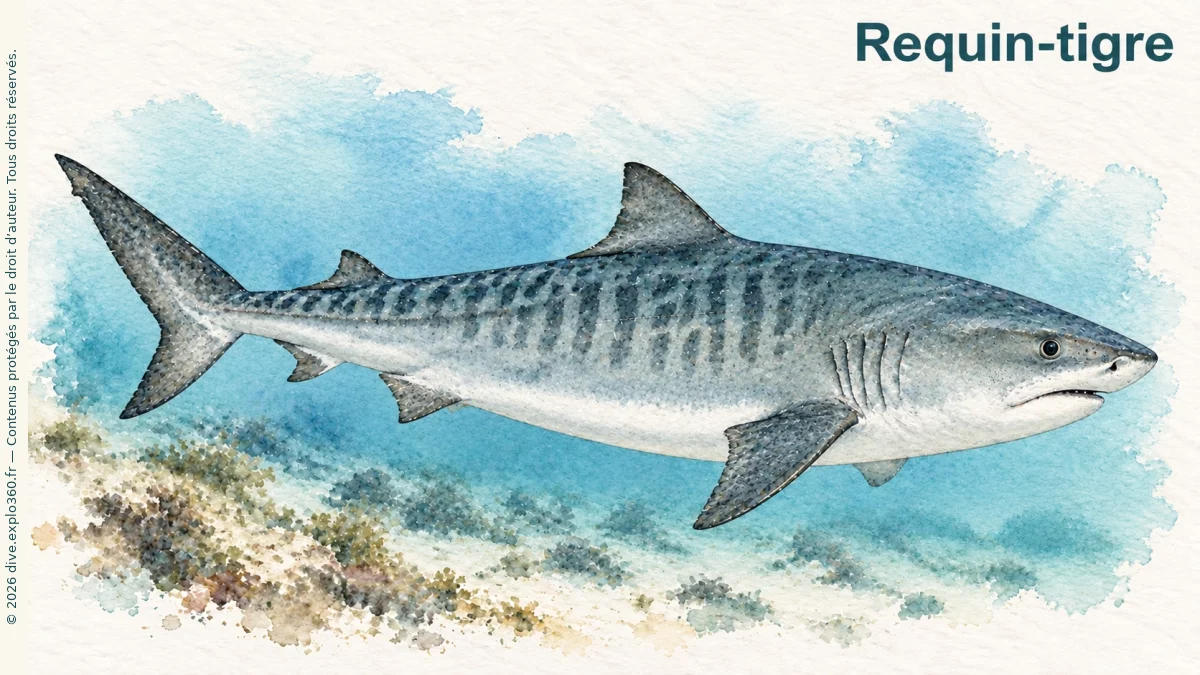
Its head is broad and the snout short. Dark bars are especially clear on young sharks. A grey-brown back contrasts with the light belly. Stripes often fade in large adults.
The upper tail lobe is elongated. Broad serrated teeth have a characteristic notch; never approach to examine them. Colour changes with growth, so faint or missing stripes in a photograph do not by themselves rule out the species.
WHERE DOES IT LIVE?
It uses warm seas, both coastal and offshore. It is documented in the Maldives. In the Mediterranean, its presence is rare or exceptional. Different seabed habitats are used and sharks can move away from islands. The species also occurs in tropical Atlantic and Pacific waters.
Some tracked individuals make long journeys. Regular use of one site can therefore coexist with movement over much larger areas. Maldivian and Red Sea publication zones document occurrence, not proof that every individual moves between those regions.
WHAT DOES IT EAT?
It eats fish, rays and sea turtles. Its diet is broader than that of many other sharks. Cephalopods and other available animals may also be taken. Its teeth can process resistant prey.
This generalist diet varies with size, location and resources. Stomach contents reveal meals, whereas tracking prey helps reveal the effects of capture risk. Those approaches answer different questions.
GO FURTHER WITH AMIGANSEAU
Unlock the full profile
Deepen your knowledge with the exclusive chapters and interactive resources included in an AMIGANSEAU licence.
- HOW DOES IT REPRODUCE?
- OUR OBSERVATIONS
- ARTICLE
Also included in the full profile
- Advanced navigation between description, ecological context, observations and behaviour
- Interactive food chain to explore the species’ feeding relationships