Partners and information

Contact us

Verification code

Tiger shark

Distribution : Maldives and tropical Indian Ocean. Also found in the Red Sea and tropical Pacific. Also present in the tropical and subtropical Atlantic. Mediterranean: rare or exceptional records.

In traditional Hawaiʻi, catching niuhi was a prestigious pursuit associated with chiefs. Historical accounts describe carefully organised expeditions involving specialist fishers and techniques designed to attract powerful sharks. The term did not correspond to a single zoological species: it could include both tiger sharks and great white sharks. The consumption of niuhi flesh was also subject to restrictions, particularly for women. The name thus belongs to a history connecting large marine predators with chiefly authority and the customary rules of Hawaiian society.

Images being acquired · Your video or photos here

Habitat of Tiger shark Habitat
Open water, Coral reef, Sand
Depth range of Tiger shark Depth
0-800 m
Biological group of Tiger shark Group
Ecological role of Tiger shark Role
Predator

Size

Often 3–4 m; large individuals exceed 5 m

Good to know

This species is legally protected in the Maldives. Observe from a distance without feeding, chasing or contact. Follow site guidance and leave a clear route.

WHAT DOES IT LOOK LIKE?

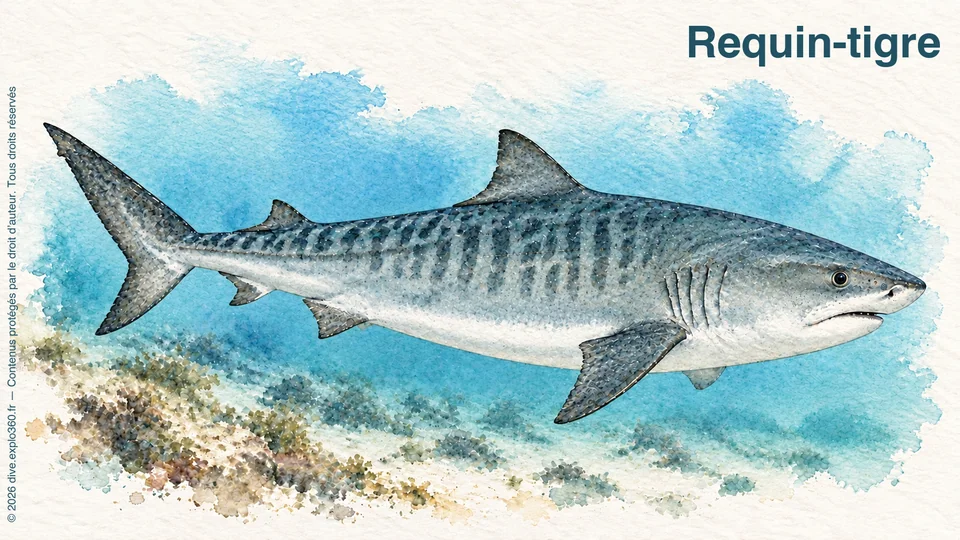
Large adult tiger sharks (Galeocerdo cuvier) may lose the bold bands that mark young sharks. The greyish-brown back contrasts with the pale belly. A broad head, short snout and long upper tail section complete the outline. The teeth are broad, serrated and notched.

WHERE DOES IT LIVE?

It uses warm seas, both coastal and offshore. It occurs around the Maldives. Different seabed habitats are used and sharks can move away from islands. The species also occurs in tropical Atlantic and Pacific waters.

Some tracked individuals make long journeys. Regular use of one site can therefore coexist with movement over much larger areas.

WHAT DOES IT EAT?

Diversity characterises tiger shark meals. It consumes fish, rays, sea turtles, cephalopods and crustaceans, varying with regional resources. It also feeds on carcasses. Serrated teeth work with head movements to tackle resistant parts and tear off pieces.

GO FURTHER WITH AMIGANSEAU

Unlock the full profile

Deepen your knowledge with the exclusive chapters and interactive resources included in an AMIGANSEAU licence.

Choose my licence
  • HOW DOES IT REPRODUCE?
  • OUR OBSERVATIONS
  • ARTICLE

Also included in the full profile

  • Advanced navigation between description, ecological context, observations and behaviour
  • Interactive food chain to explore the species’ feeding relationships
An active licence gives access to enriched profiles and AMIGANSEAU exploration tools.
Tiger shark

Understand the species

What is this species’ ecological role?

AMIGANSEAU Explorer Premium

Access enriched species profiles with advanced content (audio, infographics and detailed articles).

Explore all species easily through a single interface.

Enjoy a smooth, fast learning experience suited to every level.

🔒 The full profile is available with a paid subscription only.

Discover licences

POURSUIVRE L’EXPLORATION

Explore further

ArticleTHE SECRETS OF SANDRead the article →JourneysJourney into maerl and sandDiscover → →ArticleWhat marine animals do and why it mattersRead the article →