Habitat
 Depth
 Group
 Role
 Size
WHAT DOES IT LOOK LIKE?
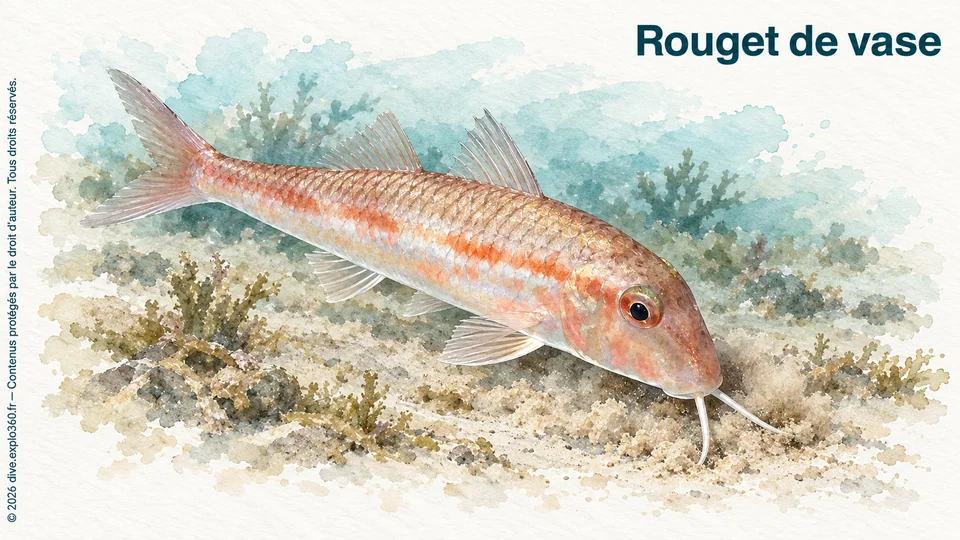
A steep forehead and a first back fin without clear bands refine comparison between the red mullet (Mullus barbatus) and striped red mullet. Two white barbels, the movable chin filaments, accompany the bulky head. The elongated body has a fairly flat pale belly beneath beige, brown or pink shades.
WHERE DOES IT LIVE?
Red mullet live mainly on mud and sand. They can form groups and occupy areas several hundred metres deep. Their presence in shallow water is also documented, particularly in the eastern Mediterranean.
They occur in the Mediterranean, Black Sea and eastern Atlantic. Young fish begin in open water before moving to the bottom; movement into deeper areas may also occur in autumn.
WHAT DOES IT EAT?
The red mullet’s two barbels explore sediment in front of its mouth. Their sensory role helps detect polychaete worms, bivalve molluscs and small crustaceans living in or against the bottom. Food need not be visible above sand or mud to be found. Growing fish take larger animals. Probing movements seek animal tissue rather than the mineral material being disturbed.
GO FURTHER WITH AMIGANSEAU
Unlock the full profile
Deepen your knowledge with the exclusive chapters and interactive resources included in an AMIGANSEAU licence.
Subscribing to Dive.Explo360 means supporting a different way to discover marine life.
Our independent platform is entirely self-funded and relies solely on subscriptions. Every licence helps us continue our work, create new content, and share what we know about the marine world with as many people as possible.
Starting at €80 per year, your support makes all the difference.
 Understand the species