Habitat
 Depth
 Group
 Role
WHAT DOES IT LOOK LIKE?
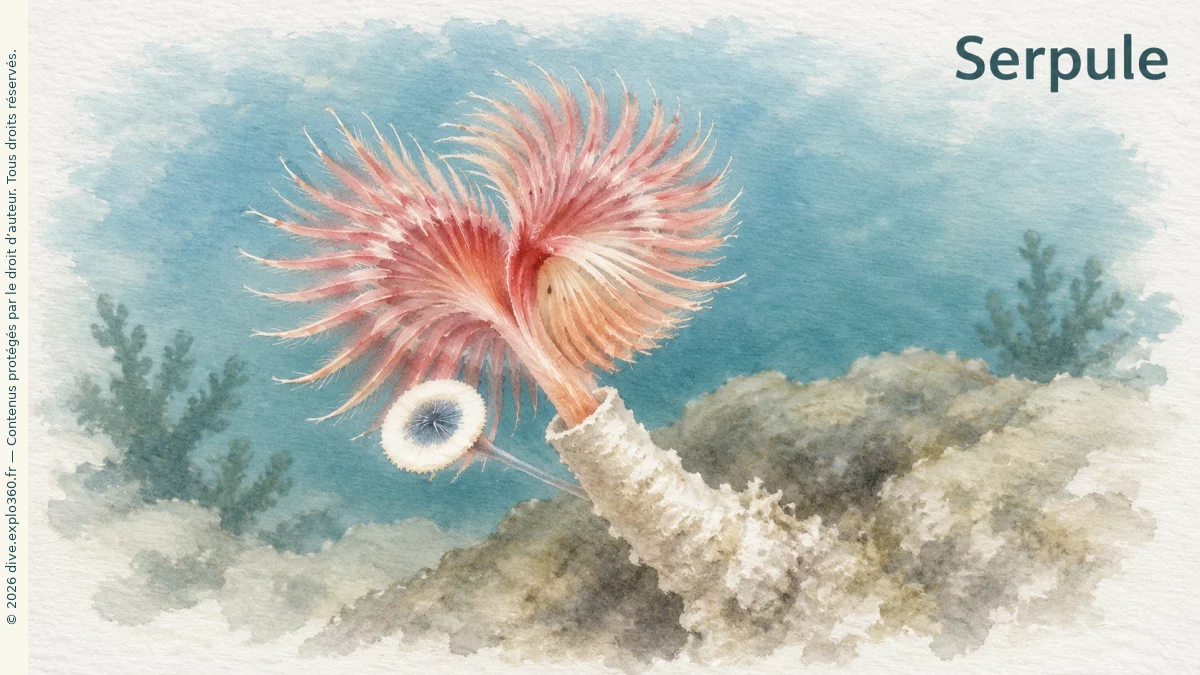
The red tubeworm is a segmented worm building a white to pinkish calcium carbonate tube, generally attached along part of its length. The body stays sheltered. Its red, pink or pale-patterned fan has two lobes.
A modified filament carries an operculum, a plug closing the tube during withdrawal. Fan and operculum shape are more useful for recognition than colour alone.
WHERE DOES IT LIVE?
It lives on hard surfaces, notably rocks and shells, in French Mediterranean habitats. It can be observed beneath overhangs or in shade, where other organisms may partly cover the tube.
An overgrown tube is not necessarily empty. The opening and fan emergence reveal activity without intervention.
WHAT DOES IT EAT?
The fan’s branching filaments retain food particles. Mucus and cilia, fine moving cell projections, help capture and convey them towards the mouth.
The fan also supports respiratory gas exchange. Exposure is necessary for these functions; repeated withdrawals caused by abrupt approaches reduce opportunities to observe filtering.
GO FURTHER WITH AMIGANSEAU
Unlock the full profile
Deepen your knowledge with the exclusive chapters and interactive resources included in an AMIGANSEAU licence.
- HOW DOES IT REPRODUCE?
- OUR OBSERVATIONS
- ARTICLE
Also included in the full profile
- Advanced navigation between description, ecological context, observations and behaviour
- Interactive food chain to explore the species’ feeding relationships