Habitat
 Depth
 Group
 Role
WHAT DOES IT LOOK LIKE?
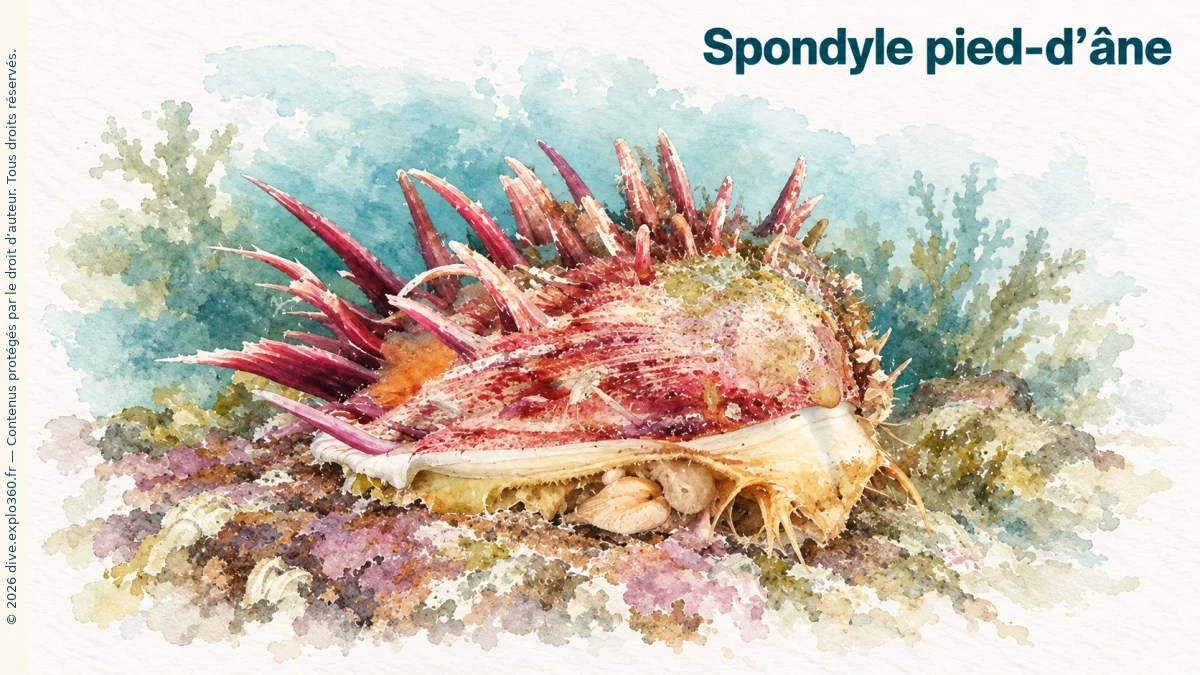
Its thick shell has two unequal valves. The deeper right valve is cemented to the support; the left forms a movable lid. Usual lengths are around six to twelve centimetres.
The visible valve is generally purple to violet, with ribs carrying irregular spines. These may be long, short or almost absent. Algae and attached organisms often cover the surface.
WHERE DOES IT LIVE?
It lives on rocks, walls and wrecks, sometimes on large mollusc shells. It occurs from a few metres to roughly fifty metres, in sites with regularly renewed water.
Direct valve attachment distinguishes it from bivalves held by threads. The spiny oyster is firmly joined to its support without being a mere mineral outgrowth.
WHAT DOES IT EAT?
It filters organic particles and plankton, small organisms carried by water. Its gills collect food inside the shell.
This is suspension feeding: it relies on particles in the water rather than prey chased or pulled from the seabed.
GO FURTHER WITH AMIGANSEAU
Unlock the full profile
Deepen your knowledge with the exclusive chapters and interactive resources included in an AMIGANSEAU licence.
- HOW DOES IT REPRODUCE?
- OUR OBSERVATIONS
- ARTICLE
Also included in the full profile
- Advanced navigation between description, ecological context, observations and behaviour
- Interactive food chain to explore the species’ feeding relationships