Partners and information

Contact us

Verification code

Hope’s elysia

Distribution : Mediterranean

The Reverend Frederick William Hope, a British entomologist who established the Oxford professorship bearing his name, is not chiefly remembered for marine research. He did, however, publish a catalogue of Italian crustaceans in Naples in 1851. Two years later, Jean-Baptiste Vérany dedicated a small Mediterranean sea slug to him, originally describing it as Actaeon hopei. Its name connects an English insect enthusiast with natural-history research along the coast of Nice in the mid-nineteenth century.

Images being acquired · Your video or photos here

Habitat of Hope’s elysia Habitat
Rocky habitat
Depth range of Hope’s elysia Depth
1-30 m
Biological group of Hope’s elysia Group
Ecological role of Hope’s elysia Role
Herbivore

Size

1–2.5 cm

WHAT DOES IT LOOK LIKE?

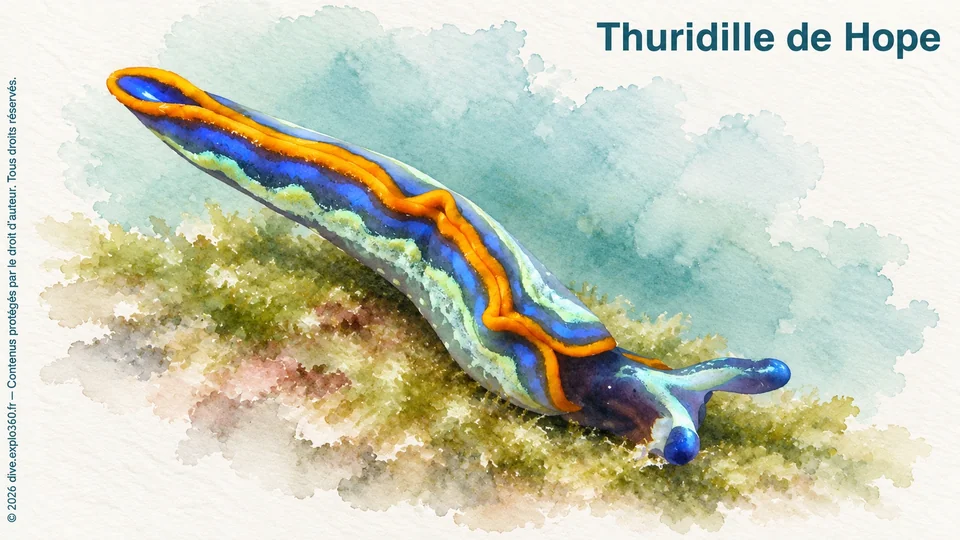
The sleeve around Hope’s elysia (Thuridilla hopei) is formed by parapodia, the two side folds meeting above the body. The head carries two rhinophores, sturdy rolled appendages. Against blue to violet or almost black colouring, marginal lines and orange edging add detail to the slender outline.

WHERE DOES IT LIVE?

Algal growth on rock provides places to look for Hope’s elysia. It moves over seabed surfaces and often uses well-lit areas. Its occurrence extends from shallow water to several tens of metres rather than a single depth.

WHAT DOES IT EAT?

Hope’s elysia accesses food by crossing algal cell walls. The toothed radula opens the covering before cell contents are sucked in. Feeding is more specific than scraping a layer of growth: fluid is extracted from cells. This mechanism characterises sacoglossans. Algae provide the resource, and the slug supplies the piercing tool and suction needed to use it.

GO FURTHER WITH AMIGANSEAU

Unlock the full profile

Deepen your knowledge with the exclusive chapters and interactive resources included in an AMIGANSEAU licence.

Choose my licence
  • HOW DOES IT REPRODUCE?
  • OUR OBSERVATIONS
  • ARTICLE

Also included in the full profile

  • Advanced navigation between description, ecological context, observations and behaviour
  • Interactive food chain to explore the species’ feeding relationships
An active licence gives access to enriched profiles and AMIGANSEAU exploration tools.
Hope’s elysia

Understand the species

What is this species’ ecological role?

AMIGANSEAU Explorer Premium

Access enriched species profiles with advanced content (audio, infographics and detailed articles).

Explore all species easily through a single interface.

Enjoy a smooth, fast learning experience suited to every level.

🔒 The full profile is available with a paid subscription only.

Discover licences

POURSUIVRE L’EXPLORATION

Explore further

ArticleWhat marine animals do and why it mattersRead the article →ArticlePHYLA WITHOUT THE FUSSRead the article →