Habitat
 Depth
 Group
 Role
 Size
WHAT DOES IT LOOK LIKE?
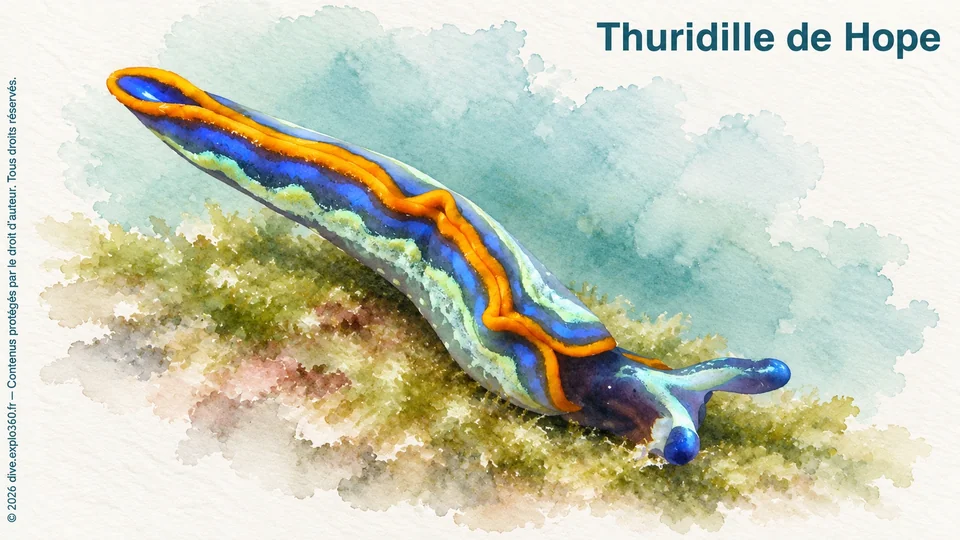
The sleeve around Hope’s elysia (Thuridilla hopei) is formed by parapodia, the two side folds meeting above the body. The head carries two rhinophores, sturdy rolled appendages. Against blue to violet or almost black colouring, marginal lines and orange edging add detail to the slender outline.
WHERE DOES IT LIVE?
Algal growth on rock provides places to look for Hope’s elysia. It moves over seabed surfaces and often uses well-lit areas. Its occurrence extends from shallow water to several tens of metres rather than a single depth.
WHAT DOES IT EAT?
Hope’s elysia accesses food by crossing algal cell walls. The toothed radula opens the covering before cell contents are sucked in. Feeding is more specific than scraping a layer of growth: fluid is extracted from cells. This mechanism characterises sacoglossans. Algae provide the resource, and the slug supplies the piercing tool and suction needed to use it.
GO FURTHER WITH AMIGANSEAU
Unlock the full profile
Deepen your knowledge with the exclusive chapters and interactive resources included in an AMIGANSEAU licence.
Subscribing to Dive.Explo360 means supporting a different way to discover marine life.
Our independent platform is entirely self-funded and relies solely on subscriptions. Every licence helps us continue our work, create new content, and share what we know about the marine world with as many people as possible.
Starting at €80 per year, your support makes all the difference.
 Understand the species