Habitat
 Depth
 Group
 Role
 Size
WHAT DOES IT LOOK LIKE?
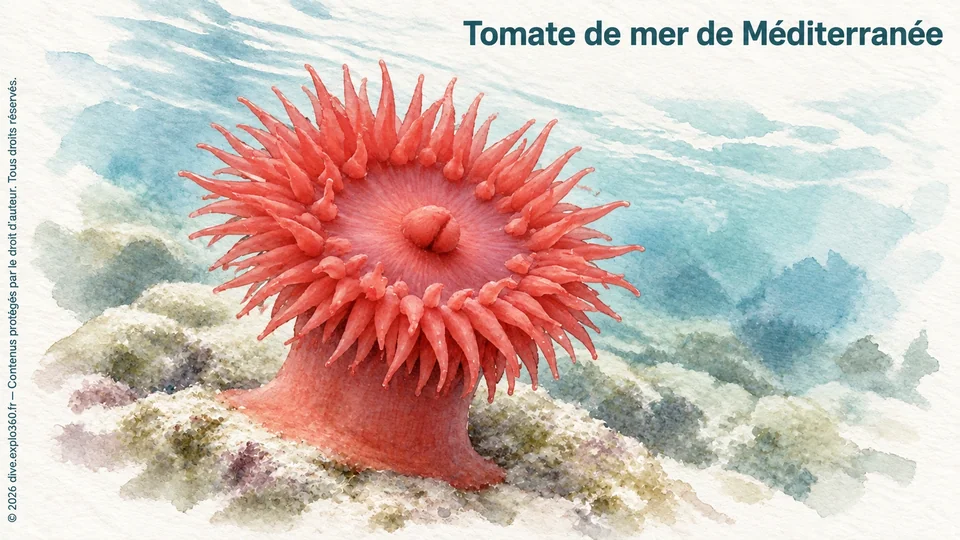
The contrast between red and a fine blue base margin often highlights this Mediterranean beadlet anemone (Actinia mediterranea). Its smooth column, the upright body section, carries an oral disc, the mouth surface, edged with tentacles. When these withdraw completely, the outline closes into a rounded tomato-like mass.
WHERE DOES IT LIVE?
It attaches to rocks, breakwaters and quay walls near the surface and in the first few metres. Changes in sea level can expose it, even in the Mediterranean where tides are smaller than on some Atlantic coasts.
Closing limits the exposed surface, while mucus helps retain water. The base also allows slow movement.
WHAT DOES IT EAT?
A Mediterranean beadlet anemone meal begins when food contacts expanded tentacles. Capture is chiefly nocturnal and includes planktonic animals, other invertebrates and small fishes, alongside animal fragments. Stinging cells help immobilise prey while tentacles bring it to the central mouth. Food enters the digestive cavity, and unassimilated material later leaves through the same opening rather than a separate anus.
GO FURTHER WITH AMIGANSEAU
Unlock the full profile
Deepen your knowledge with the exclusive chapters and interactive resources included in an AMIGANSEAU licence.
Subscribing to Dive.Explo360 means supporting a different way to discover marine life.
Our independent platform is entirely self-funded and relies solely on subscriptions. Every licence helps us continue our work, create new content, and share what we know about the marine world with as many people as possible.
Starting at €80 per year, your support makes all the difference.
 Understand the species