Partners and information

Contact us

Verification code

Common torpedo

Distribution : Mediterranean and eastern Atlantic. Mainly shallow soft-bottom encounters, with deeper records to 400 m.

In the eastern Mediterranean, newborn common torpedoes became the subjects of an unusual experiment: measuring their electrical output from the beginning of life. The young came from females caught off Israel. Researchers discovered that their electric organs were functional almost immediately. They then followed the changing discharges over the first months.

Images being acquired · Your video or photos here

Habitat of Common torpedo Habitat
Sand, Mud
Depth range of Common torpedo Depth
2-400 m
Biological group of Common torpedo Group
Ecological role of Common torpedo Role
Predator

Size

Often 20–40 cm; published maximum 60 cm total length

Good to know

Can produce an electric discharge. Do not touch, uncover or handle.

WHAT DOES IT LOOK LIKE?

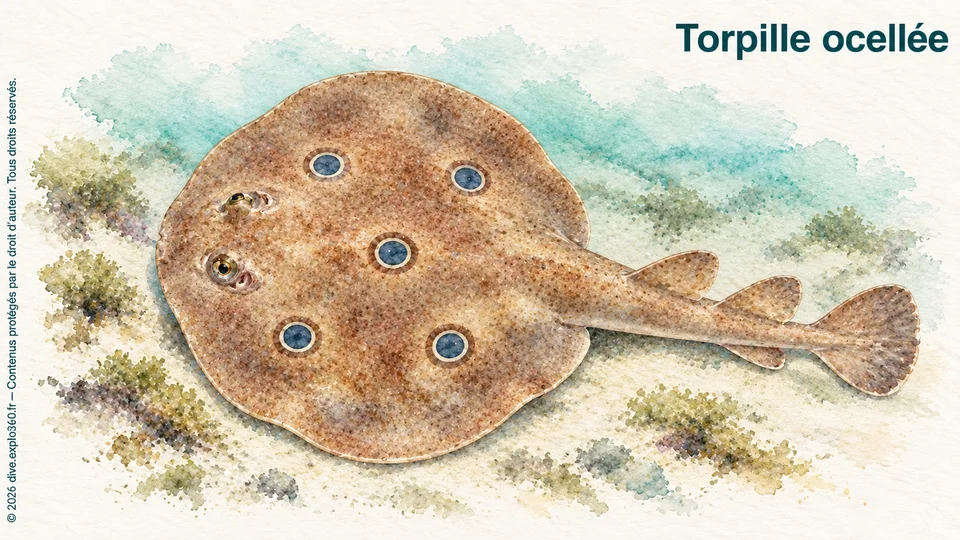
The common torpedo’s blue spots resemble eyes, but they are patterns. Often five, they are ringed with dark then pale colours on a rounded brown disc. The short robust tail carries two fins above and one at the tip.

GO FURTHER WITH AMIGANSEAU

Unlock the full profile

Deepen your knowledge with the exclusive chapters and interactive resources included in an AMIGANSEAU licence.

Choose my licence
  • WHERE DOES IT LIVE?
  • WHAT DOES IT EAT?
  • HOW DOES IT REPRODUCE?

Also included in the full profile

  • Advanced navigation between description, ecological context, observations and behaviour
  • Interactive food chain to explore the species’ feeding relationships
An active licence gives access to enriched profiles and AMIGANSEAU exploration tools.
Common torpedo

Understand the species

What is this species’ ecological role?

AMIGANSEAU Explorer Premium

Access enriched species profiles with advanced content (audio, infographics and detailed articles).

Explore all species easily through a single interface.

Enjoy a smooth, fast learning experience suited to every level.

🔒 The full profile is available with a paid subscription only.

Discover licences

POURSUIVRE L’EXPLORATION

Explore further

ArticleTHE SECRETS OF SANDRead the article →ArticleWhat marine animals do and why it mattersRead the article →ArticlePHYLA WITHOUT THE FUSSRead the article →