Partners

Contact us

Verification code

Common torpedo

Distribution : Mediterranean and eastern Atlantic. Mainly shallow soft-bottom encounters, with deeper records to 400 m.

At Tel Aviv University, researchers studied common torpedoes born to females caught in autumn along Israel’s Mediterranean coast. Published in 1979 under the name Torpedo ocellata, their work combined observations of feeding, measurements of growth and recordings of electrical discharges. The young initially weighed about eleven grams and were fed live blennies. This allowed the researchers to investigate the early development of an electrical system already functioning at birth.

Images being acquired · Your video or photos here

Habitat of Common torpedo Habitat
Sand, Mud
Depth range of Common torpedo Depth
2-400 m
Biological group of Common torpedo Group
Ecological role of Common torpedo Role
Predator

Size

Often 20–40 cm; published maximum 60 cm total length

Good to know

Can produce an electric discharge. Do not touch, uncover or handle.

WHAT DOES IT LOOK LIKE?

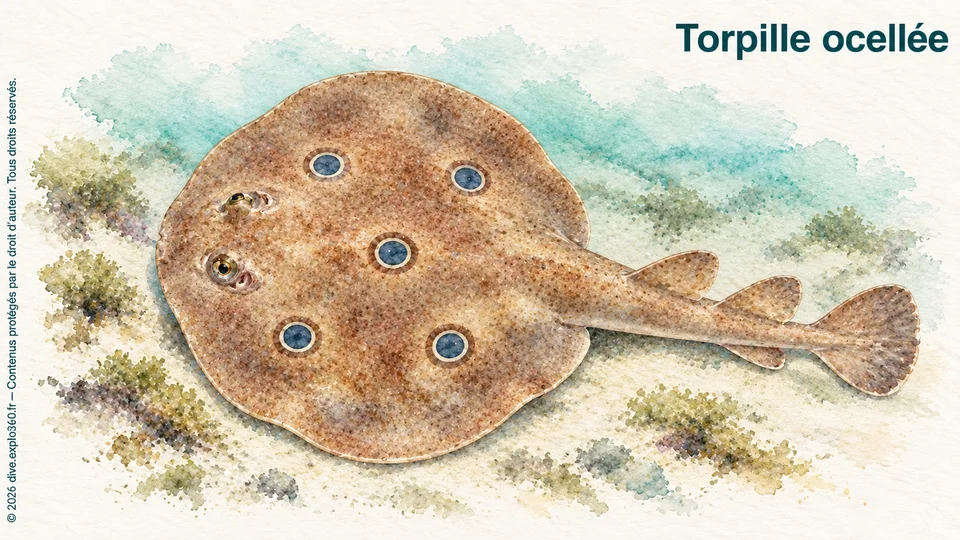
The usual five ocelli, blue spots with dark and pale rings, draw attention to the common torpedo (Torpedo torpedo). Their number is not fixed, however. The brown disc is rounded, thick and smooth; the real eyes sit towards the front. The robust tail has two closely spaced fins above and one at the tip.

WHERE DOES IT LIVE?

It lives on sandy and sandy-muddy seabeds in the Mediterranean and eastern Atlantic, from shallow water down to 400 m. When it buries itself, its colour blends with the sediment and only part of its body remains visible.

WHAT DOES IT EAT?

Concealed on soft seabed, the common torpedo waits for prey to come within reach. Its electric organs produce a discharge that immobilises prey before feeding. Benthic fish supply most of its food, including soles, red mullet and gobies; some crustaceans supplement catches. Menu composition can vary with season and prey availability.

GO FURTHER WITH AMIGANSEAU

Unlock the full profile

Deepen your knowledge with the exclusive chapters and interactive resources included in an AMIGANSEAU licence.

Subscribing to Dive.Explo360 means supporting a different way to discover marine life.

Our independent platform is entirely self-funded and relies solely on subscriptions. Every licence helps us continue our work, create new content, and share what we know about the marine world with as many people as possible.

Starting at €80 per year, your support makes all the difference.
Choose my licence
An active licence gives access to enriched profiles and AMIGANSEAU exploration tools.
Common torpedo

Understand the species

What is this species’ ecological role?

AMIGANSEAU Explorer Premium

Access enriched species profiles with advanced content (audio, infographics and detailed articles).

Explore all species easily through a single interface.

Enjoy a smooth, fast learning experience suited to every level.

🔒 The full profile is available with a paid subscription only.

Discover licences

POURSUIVRE L’EXPLORATION

Explore further

ArticleTHE SECRETS OF SANDRead the article →JourneysJourney into maerl and sandDiscover → →ArticleWhat marine animals do and why it mattersRead the article →