Habitat
 Depth
 Group
 Role
WHAT DOES IT LOOK LIKE?
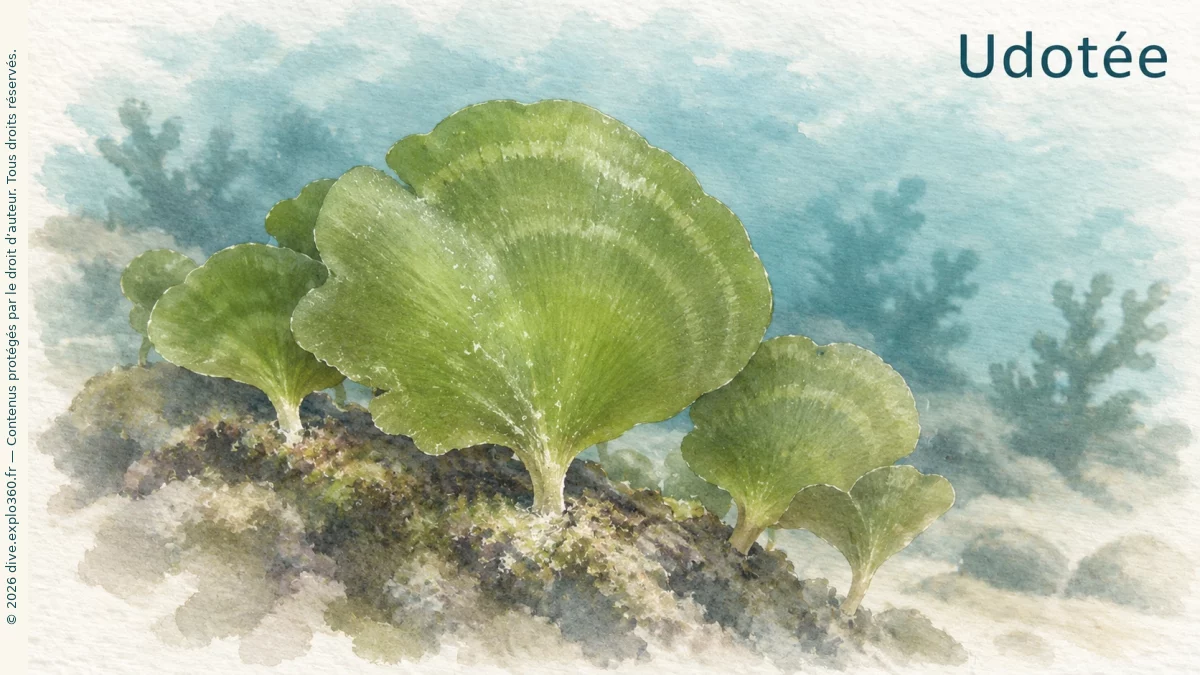
The udotea has a thallus, the algal body, consisting of a stalk and fan-shaped blade. The green blade is not calcified and may show paler concentric lines. Its edge sometimes becomes irregular or torn.
It is siphonous: filaments contain many nuclei within shared cellular contents, without regular cross-walls. Looking like a small leaf does not make it structurally equivalent to a land-plant leaf.
WHERE DOES IT LIVE?
It occupies dim rocky surfaces, steep walls and communities near Mediterranean seagrass beds. It occurs along French coasts.
The base can persist while the blade regresses, then produce a new upright part.
WHAT DOES IT EAT?
Photosynthesis produces organic matter using light and carbon available in water. Dissolved mineral nutrients provide other resources needed for growth.
Attachment and nutrition are distinct functions. The alga does not obtain all food from rock through a root: exchange occurs with surrounding water.
GO FURTHER WITH AMIGANSEAU
Unlock the full profile
Deepen your knowledge with the exclusive chapters and interactive resources included in an AMIGANSEAU licence.
- HOW DOES IT REPRODUCE?
- OUR OBSERVATIONS
- ARTICLE
Also included in the full profile
- Advanced navigation between description, ecological context, observations and behaviour
- Interactive food chain to explore the species’ feeding relationships