Habitat
 Depth
 Group
 Role
WHAT DOES IT LOOK LIKE?
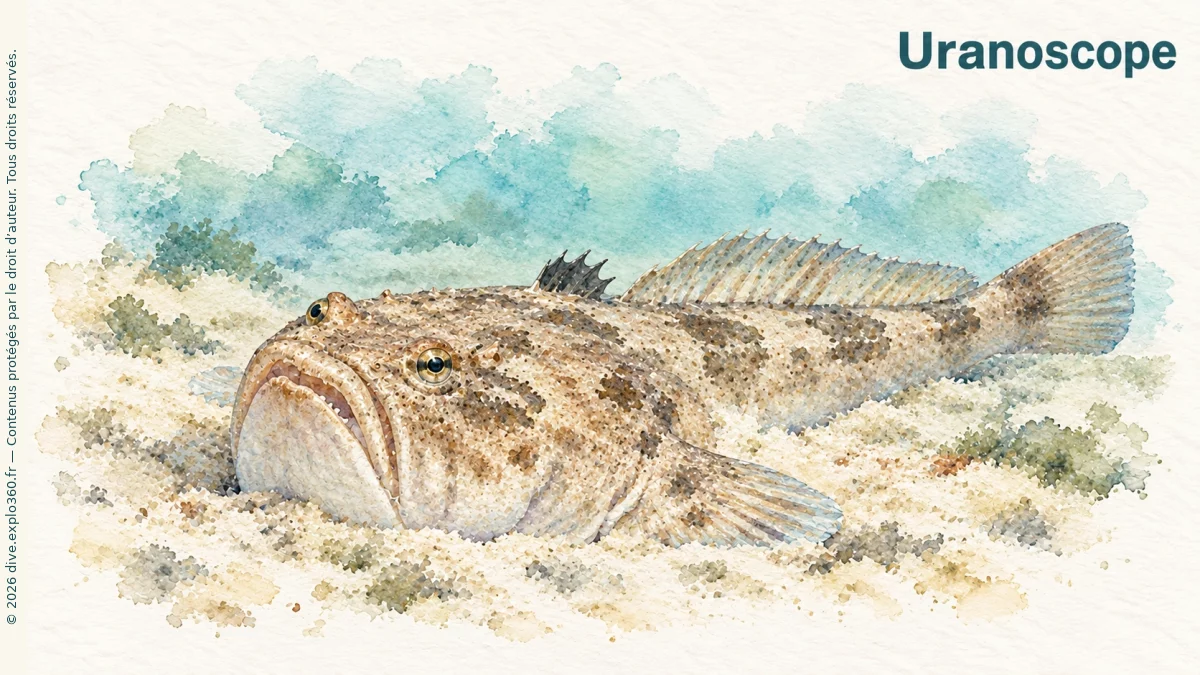
The Atlantic stargazer has a heavy anterior body tapering towards the tail. Raised eyes sit on the flattened upper head, above a very large upward-facing mouth. An elongated fleshy appendage lies on the lower jaw. The first dorsal is black and other fins may have bluish margins. Brown to yellowish mottling softens the body outline against sediment.
WHERE DOES IT LIVE?
Burial characterises its life on sand and mud. Records cover the Mediterranean, Black Sea and part of the eastern Atlantic. It can be seen in shallow water and also occupies deeper offshore bottoms down to 400 m. An account for divers should preserve the distinction between accessible habitat and the broader depth distribution.
WHAT DOES IT EAT?
It has organs that produce electrical pulses and sounds, as well as a small lure used to attract prey.
GO FURTHER WITH AMIGANSEAU
Unlock the full profile
Deepen your knowledge with the exclusive chapters and interactive resources included in an AMIGANSEAU licence.
- HOW DOES IT REPRODUCE?
- OUR OBSERVATIONS
- ARTICLE
Also included in the full profile
- Advanced navigation between description, ecological context, observations and behaviour
- Interactive food chain to explore the species’ feeding relationships