Habitat
 Depth
 Group
 Role
WHAT DOES IT LOOK LIKE?
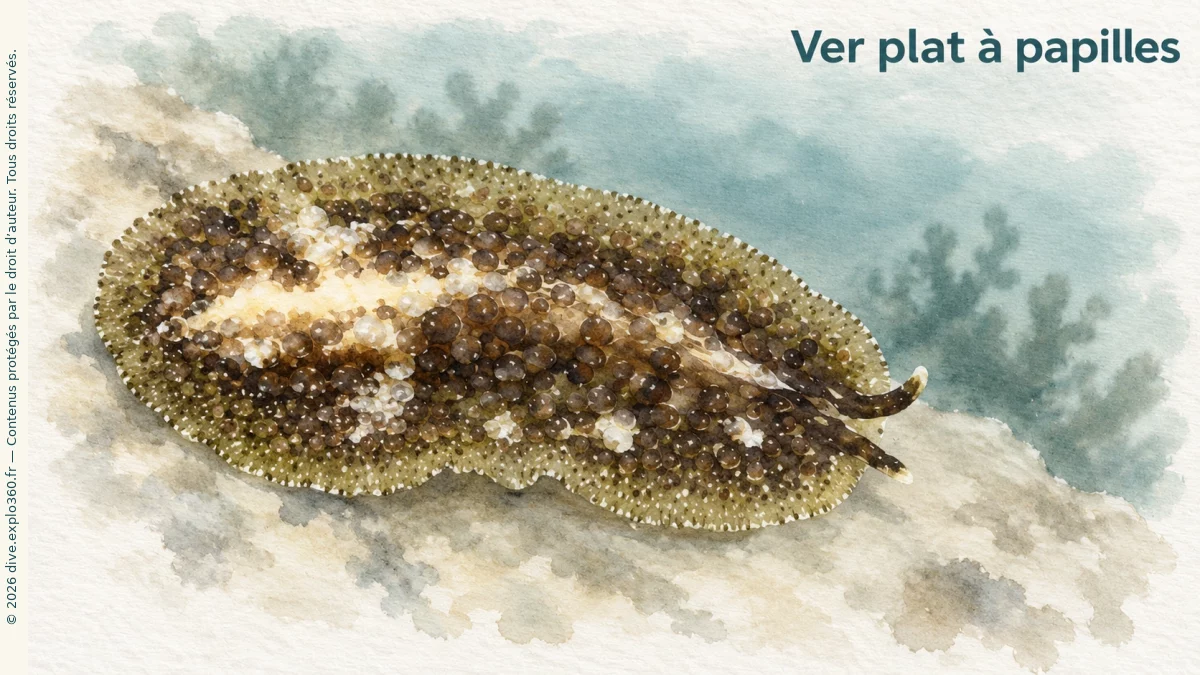
The papillose flatworm has an oval flattened body, thicker centrally, with flexible, sometimes folded margins. Papillae, small dorsal projections, cover the brown to reddish-brown surface. A paler pattern can form a cross along the body axis.
Two pseudotentacles, folds of the anterior margin, mark the head. The underside is paler. Posture can strongly alter one individual’s outline.
WHERE DOES IT LIVE?
It occurs on hard surfaces, beneath stones, among algae and within mussel communities. French Mediterranean presence is documented. It is often inconspicuous by day.
Night observation or close attention to passages between organisms can reveal it without disturbing the seabed. Systematically turning stones changes the shelters being sought.
WHAT DOES IT EAT?
Attached animals contribute to its food. Observations mention bryozoans and sponges; a publication on Didemnum fulgens also cites occasional consumption by this flatworm.
That relationship is worth retaining by precise name. Turning it into “eats all ascidians” would exceed the observation. Not every encounter on one surface is a meal.
GO FURTHER WITH AMIGANSEAU
Unlock the full profile
Deepen your knowledge with the exclusive chapters and interactive resources included in an AMIGANSEAU licence.
- HOW DOES IT REPRODUCE?
- OUR OBSERVATIONS
- ARTICLE
Also included in the full profile
- Advanced navigation between description, ecological context, observations and behaviour
- Interactive food chain to explore the species’ feeding relationships