Habitat
 Depth
 Group
 Role
WHAT DOES IT LOOK LIKE?
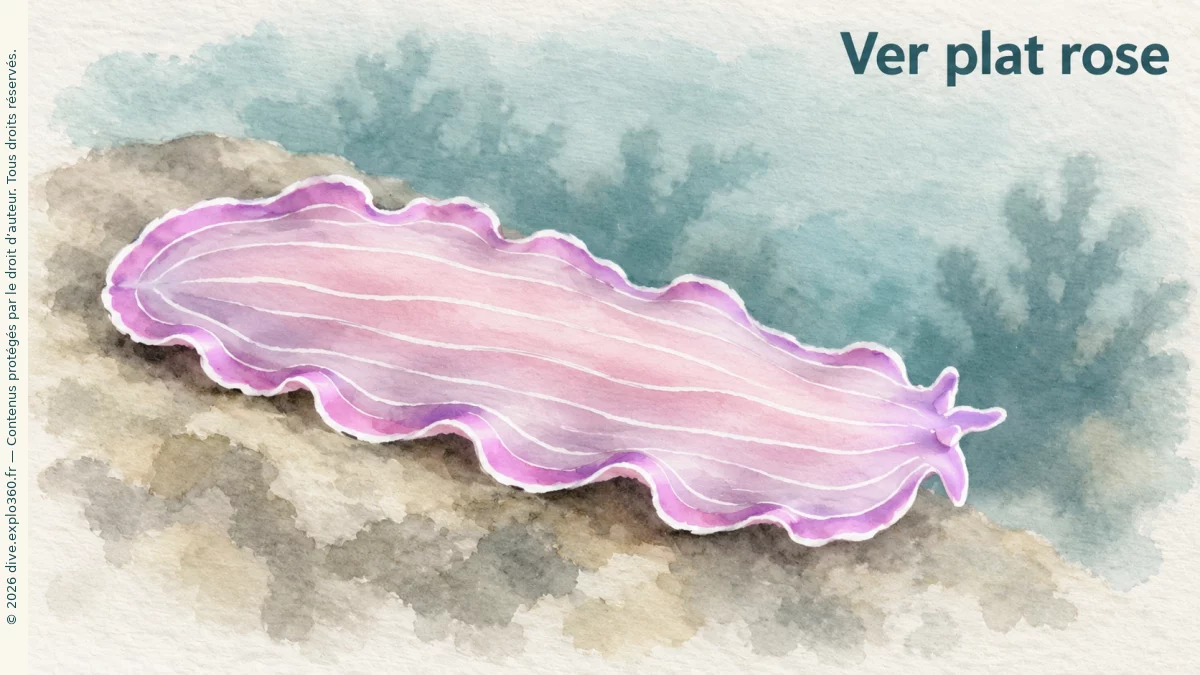
The form called Prostheceraeus roseus has a leaf-like, very thin pink to mauve body with fine white lines. Contrasting margins and two raised anterior folds form pseudotentacles, extensions of the body edge.
It lengthens or shortens while gliding, so apparent size changes with posture. Good lighting preserves patterns that ambient light can make look bluer at depth.
WHERE DOES IT LIVE?
It crosses rocky surfaces, walls rich in attached life and crevices along French Mediterranean coasts. It may occur near calcifying algae, sponges, bryozoans and ascidians covering those features.
These varied neighbours do not alone describe its diet. Documenting feeding requires following contact with a particular organism.
WHAT DOES IT EAT?
Small Pycnoclavella ascidians are documented prey. The pharynx, a muscular digestive part, extends through the mouth to take food tissues. The digestive tract has no separate anus.
Comparative tests found preference for Pycnoclavella communis over Pycnoclavella nana and Pycnoclavella aurilucens. Observed preference should not become an absolute claim of exclusivity.
GO FURTHER WITH AMIGANSEAU
Unlock the full profile
Deepen your knowledge with the exclusive chapters and interactive resources included in an AMIGANSEAU licence.
- HOW DOES IT REPRODUCE?
- OUR OBSERVATIONS
- ARTICLE
Also included in the full profile
- Advanced navigation between description, ecological context, observations and behaviour
- Interactive food chain to explore the species’ feeding relationships