Habitat
 Depth
 Group
 Role
 Size
WHAT DOES IT LOOK LIKE?
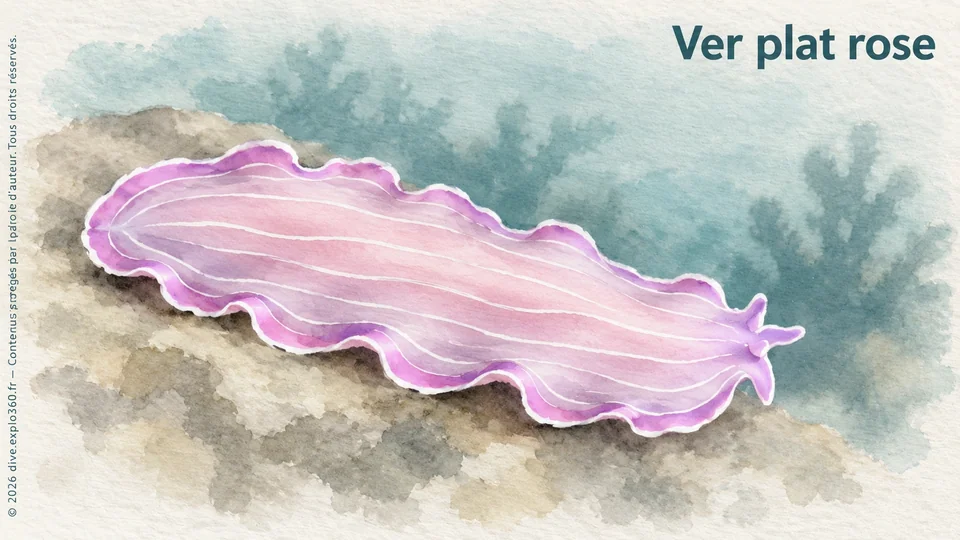
White lines follow the length of the pink flatworm (Prostheceraeus roseus), whose leaf-thin body ranges from pink to mauve. The contrasting edge ripples and two front folds form pseudotentacles, upright extensions of the outline. Posture noticeably changes this flexible shape.
WHERE DOES IT LIVE?
Walls covered in attached life and spaces within crevices provide places to observe the pink flatworm in the French Mediterranean. It moves over rock near calcareous algae, sponges, bryozoans and ascidians. The surfaces and recesses within this community form its immediate surroundings.
WHAT DOES IT EAT?
The pink flatworm feeds on small colonial sea squirts. Its pharynx can emerge through the mouth to remove and draw in tissues. Undigested residues leave through the same ventral opening. Trials comparing three sea-squirt species found a preference for the common tiny claveline. This does not exclude other catches: several related ascidians are documented prey. Feeding occurs beneath the flatworm’s striped pink body.
GO FURTHER WITH AMIGANSEAU
Unlock the full profile
Deepen your knowledge with the exclusive chapters and interactive resources included in an AMIGANSEAU licence.
Subscribing to Dive.Explo360 means supporting a different way to discover marine life.
Our independent platform is entirely self-funded and relies solely on subscriptions. Every licence helps us continue our work, create new content, and share what we know about the marine world with as many people as possible.
Starting at €80 per year, your support makes all the difference.
 Understand the species