Habitat
 Depth
 Group
 Role
WHAT DOES IT LOOK LIKE?
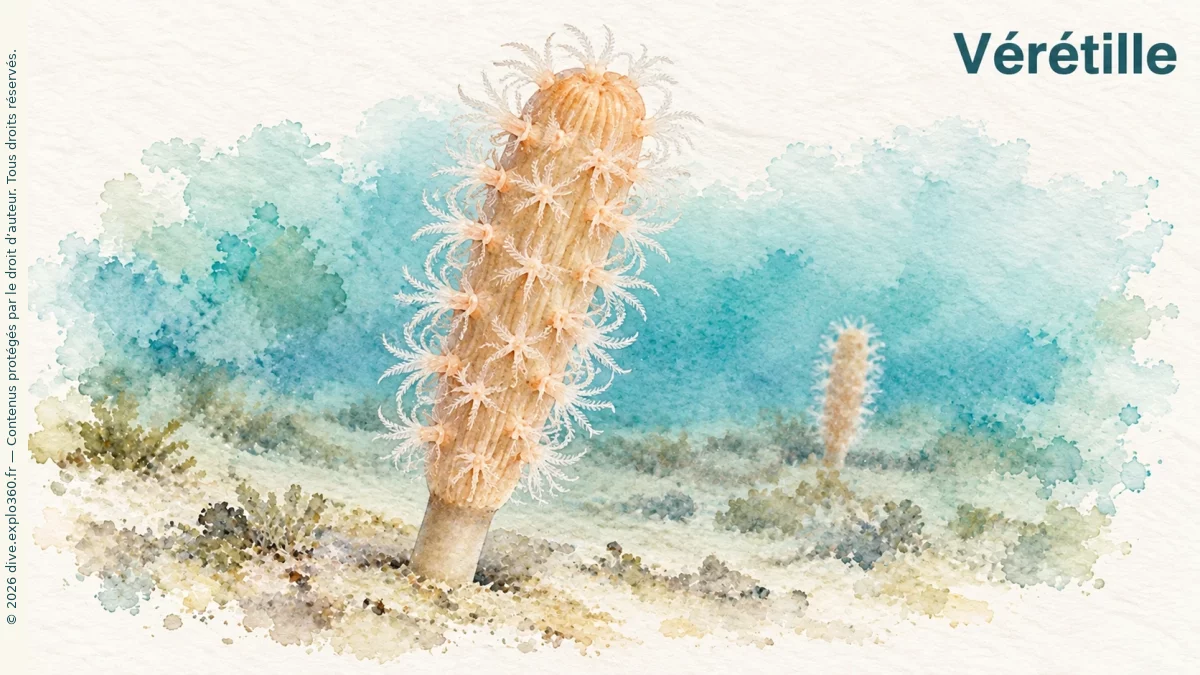
The cylindrical sea pen is a colonial octocoral with an unbranched fleshy beige to orange cylinder. Whitish feeding polyps cover its circumference. Each has eight pinnate tentacles whose fine side branches are not extra tentacles. Expanded height can reach about 50 cm. A bare lower peduncle extends into sediment. The colony is not a flattened feather.
WHERE DOES IT LIVE?
It anchors in sandy or muddy bottoms in the Mediterranean and eastern Atlantic, between 15 and 188 m. Contracted or partly buried colonies are harder to spot. The seabed and water movements also influence where they occur.
WHAT DOES IT EAT?
Open polyps collect waterborne organic particles. Their peripheral arrangement creates many interception points around the cylinder. Feeding accounts do not justify naming a particular prey from open-polyps photographs. Resources can remain invisible to a diver. Food addition and deliberate sediment clouds should never be used to illustrate capture.
GO FURTHER WITH AMIGANSEAU
Unlock the full profile
Deepen your knowledge with the exclusive chapters and interactive resources included in an AMIGANSEAU licence.
- HOW DOES IT REPRODUCE?
- OUR OBSERVATIONS
- ARTICLE
Also included in the full profile
- Advanced navigation between description, ecological context, observations and behaviour
- Interactive food chain to explore the species’ feeding relationships