Habitat
 Depth
 Group
 Role
WHAT DOES IT LOOK LIKE?
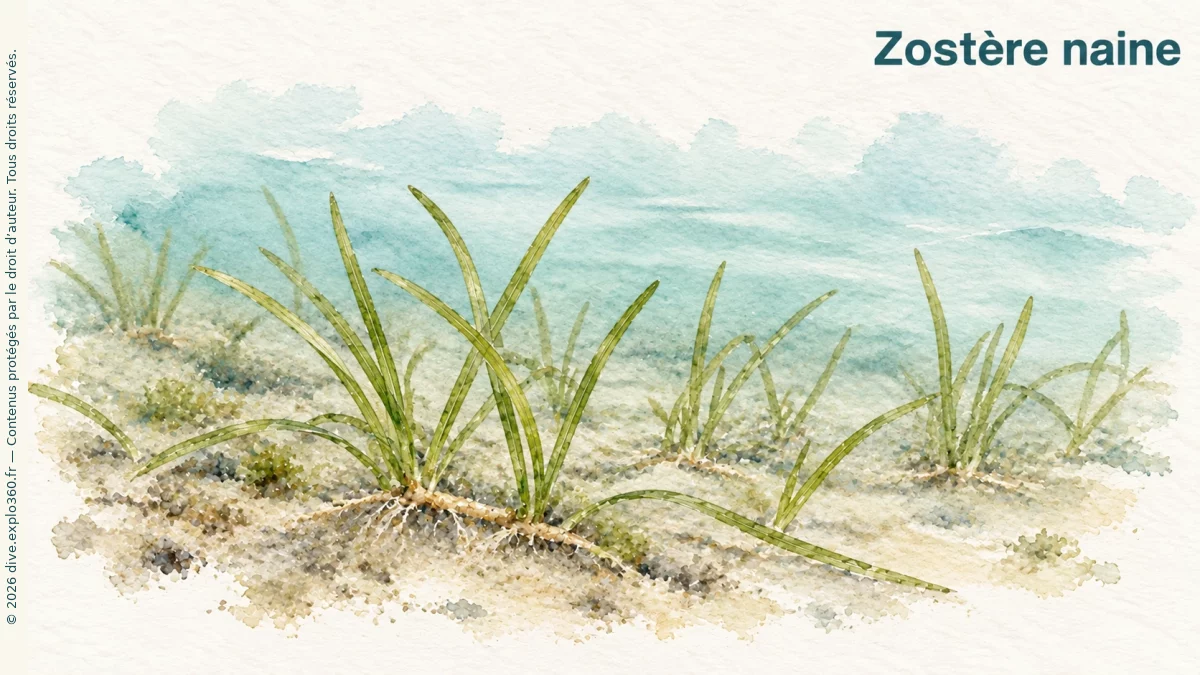
The dwarf eelgrass has pale green flat ribbon leaves about 1–1.5 mm wide and up to roughly 20 cm long. Three longitudinal veins cross smooth-edged blades. A creeping rooted rhizome links shoots. Narrow leaves and overall size distinguish it from Neptune grass and broader-leaved species. Colour alone varies with lighting and material growing or deposited on leaves.
WHERE DOES IT LIVE?
Mediterranean lagoons and northeast Atlantic shores hold documented populations. Very shallow sandy mud is characteristic. The metadata interval of 0–1.5 m represents common DORIS habitat rather than an absolute species limit. Salinity, turbidity, exposure and immersion should be considered together. Depth alone cannot explain meadow condition.
WHAT DOES IT EAT?
Photosynthesis turns light energy and mineral resources into organic matter. Dissolved nutrients support growth. Roots and rhizomes anchor the plant and help retain sediment, while leaves add underwater structure. Producer and habitat-engineer roles describe these functions, but do not quantify local production, storage or stability without an appropriate method.
GO FURTHER WITH AMIGANSEAU
Unlock the full profile
Deepen your knowledge with the exclusive chapters and interactive resources included in an AMIGANSEAU licence.
- HOW DOES IT REPRODUCE?
- OUR OBSERVATIONS
- ARTICLE
Also included in the full profile
- Advanced navigation between description, ecological context, observations and behaviour
- Interactive food chain to explore the species’ feeding relationships