


 Habitat
 Depth
 Group
 Role
 Average size
WHAT DOES IT LOOK LIKE?
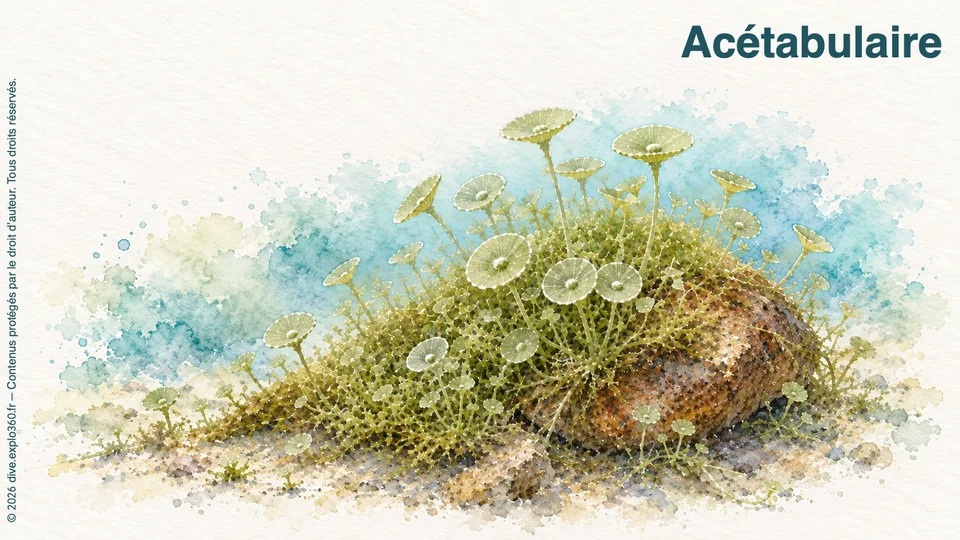
A parasol at the tip of a slender stalk gives mermaid’s wineglass (Acetabularia acetabulum) something of a tiny mushroom’s outline. Its circular disc is cup-shaped, with a smooth margin.
The stalk, or peduncle, reaches about 5 cm high beneath a disc around 1 cm across. Pale-green colour can shade into white.
WHERE DOES IT LIVE?
A shell or limestone fragment can support mermaid’s wineglass as readily as a rock. It grows in calm, well-lit coastal shallows where light reaches its attachment surface. Mainly Mediterranean, it also occurs in some Atlantic regions.
WHAT DOES IT EAT?
Mermaid’s wineglass does not catch prey. Like other green algae, it uses light to make the organic matter it needs to grow. Photosynthesis takes place in its chloroplasts, which contain pigments that capture light energy.
Using water and dissolved inorganic carbon, it produces compounds including sugars. It also absorbs minerals from seawater for its normal functioning. Its nutrition therefore depends on light and substances available in its surroundings.
GO FURTHER WITH AMIGANSEAU
Unlock the full profile
Deepen your knowledge with the exclusive chapters and interactive resources included in an AMIGANSEAU licence.
- HOW DOES IT REPRODUCE?
- OUR OBSERVATIONS
- ARTICLE
Also included in the full profile
- Advanced navigation between description, ecological context, observations and behaviour
- Interactive food chain to explore the species’ feeding relationships
- Natural history podcast and dive debrief
- Infographic and illustrated summary profile
- Additional photographic observations
 Understand the species