


 Habitat
 Depth
 Group
 Role
 Average size
WHAT DOES IT LOOK LIKE?
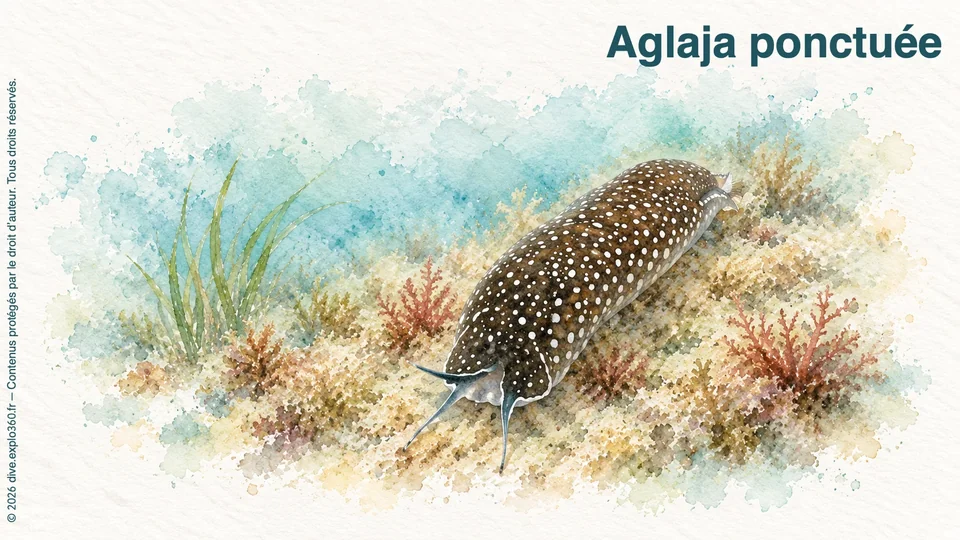
White spots stand out against the brown body of this sea slug (Aglaja tricolorata), although almost black individuals may have only a few. Two broad side folds, the parapodia, rise towards the top of its elongated body.
A shield covers the head and spreads into a pointed corner on each side. At the rear, the mantle—the tissue covering this part of the body—ends in two rounded lobes. Only the left lobe carries a thin extension. No shell can be seen externally.
WHERE DOES IT LIVE?
On sandy or muddy-sand seabeds, the three-coloured aglaja moves over the sediment surface. These soft bottoms are its main habitats in the Mediterranean and neighbouring Atlantic. Encounters are often shallow, but the species is not confined to shallow water.
WHAT DOES IT EAT?
Sand pushed aside by the three-coloured aglaja can be a sign that it is searching for food. Its exact prey remain poorly documented, however. Small molluscs found in the digestive tract provide evidence without establishing their usual importance. Its mouthparts allow it to suck in food without a radula.
GO FURTHER WITH AMIGANSEAU
Unlock the full profile
Deepen your knowledge with the exclusive chapters and interactive resources included in an AMIGANSEAU licence.
- HOW DOES IT REPRODUCE?
- OUR OBSERVATIONS
- ARTICLE
Also included in the full profile
- Advanced navigation between description, ecological context, observations and behaviour
- Interactive food chain to explore the species’ feeding relationships
- Natural history podcast and dive debrief
- Infographic and illustrated summary profile
 Understand the species
