Habitat
 Depth
 Group
 Role
WHAT DOES IT LOOK LIKE?
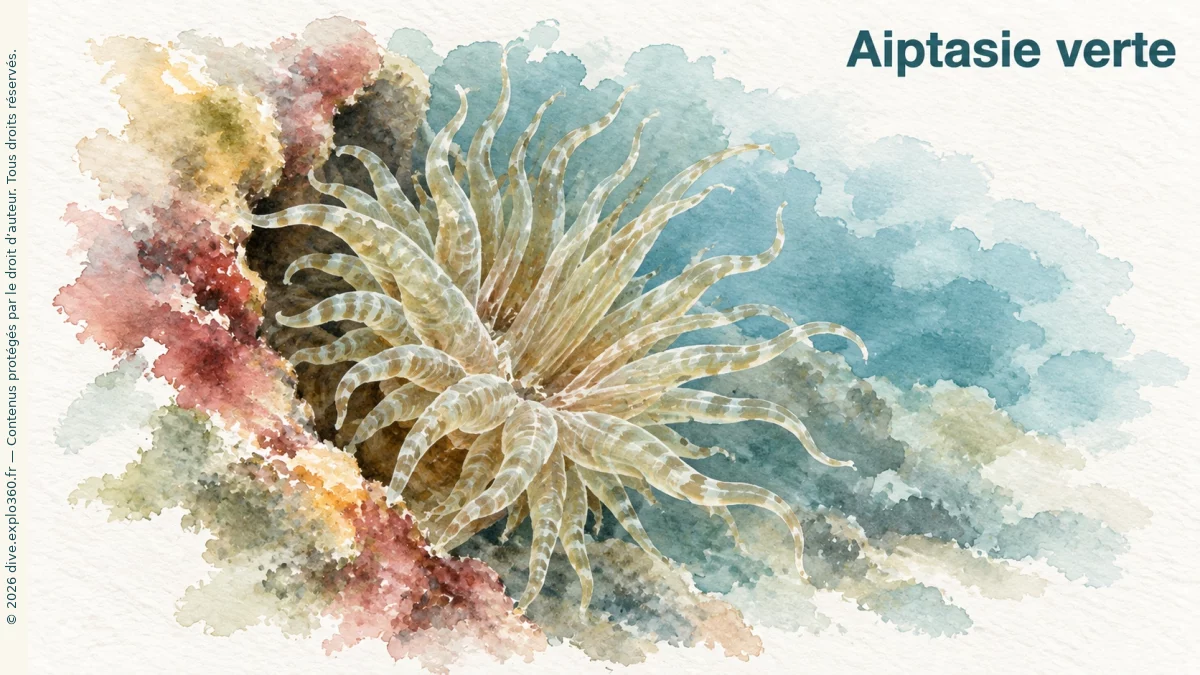
The body forms a column up to around twelve centimetres high and three centimetres across. It is rarely wholly visible because it often occupies a hole. Many tentacles arranged in rings surround the central mouth.
Broad at the base and sharply tapered, the tentacles resemble flames. They are translucent and marbled with pale networks against brown, green or bluish shades. Colour varies enough that “green” alone cannot identify the species.
WHERE DOES IT LIVE?
It attaches in cracks and holes on Mediterranean rocky seabeds, from the surface to around thirty metres according to field descriptions. The refuge shelters much of the column while tentacles extend beyond it.
Attachment is not permanent in the way of an organism cemented to rock. The anemone can use its base and contractions to change position slowly. Apparent size therefore also depends on extension and the depth of the occupied hollow.
WHAT DOES IT EAT?
It is carnivorous. Tentacles bear stinging cells that help catch small prey, which is then brought to the mouth. This is not simply passive water filtering like a sponge.
Microscopic algae may also live in the tissues. This is symbiosis, a lasting association between organisms of different species. These partners are not food being digested; their photosynthetic activity uses light to produce organic matter.
GO FURTHER WITH AMIGANSEAU
Unlock the full profile
Deepen your knowledge with the exclusive chapters and interactive resources included in an AMIGANSEAU licence.
- HOW DOES IT REPRODUCE?
- OUR OBSERVATIONS
- ARTICLE
Also included in the full profile
- Advanced navigation between description, ecological context, observations and behaviour
- Interactive food chain to explore the species’ feeding relationships