Habitat
 Depth
 Group
 Role
 Average size
WHAT DOES IT LOOK LIKE?
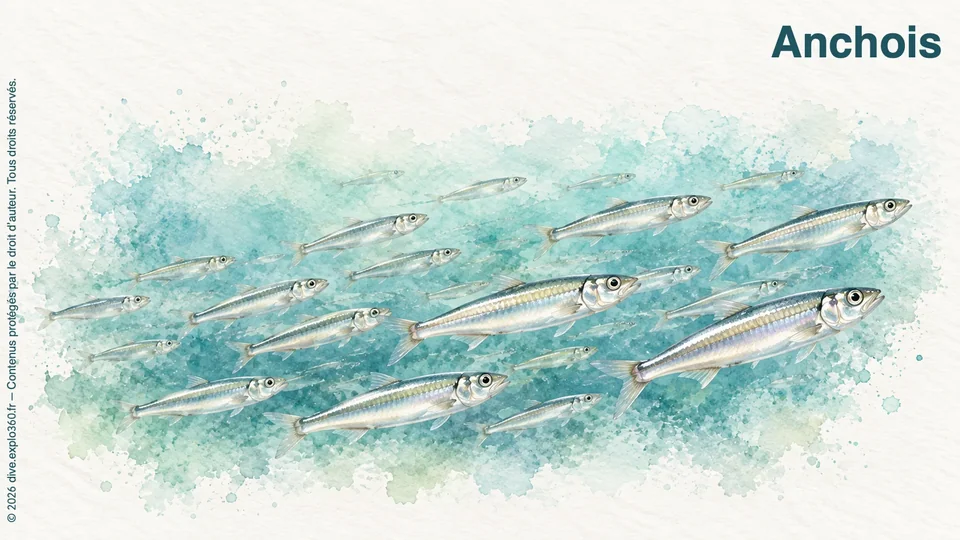
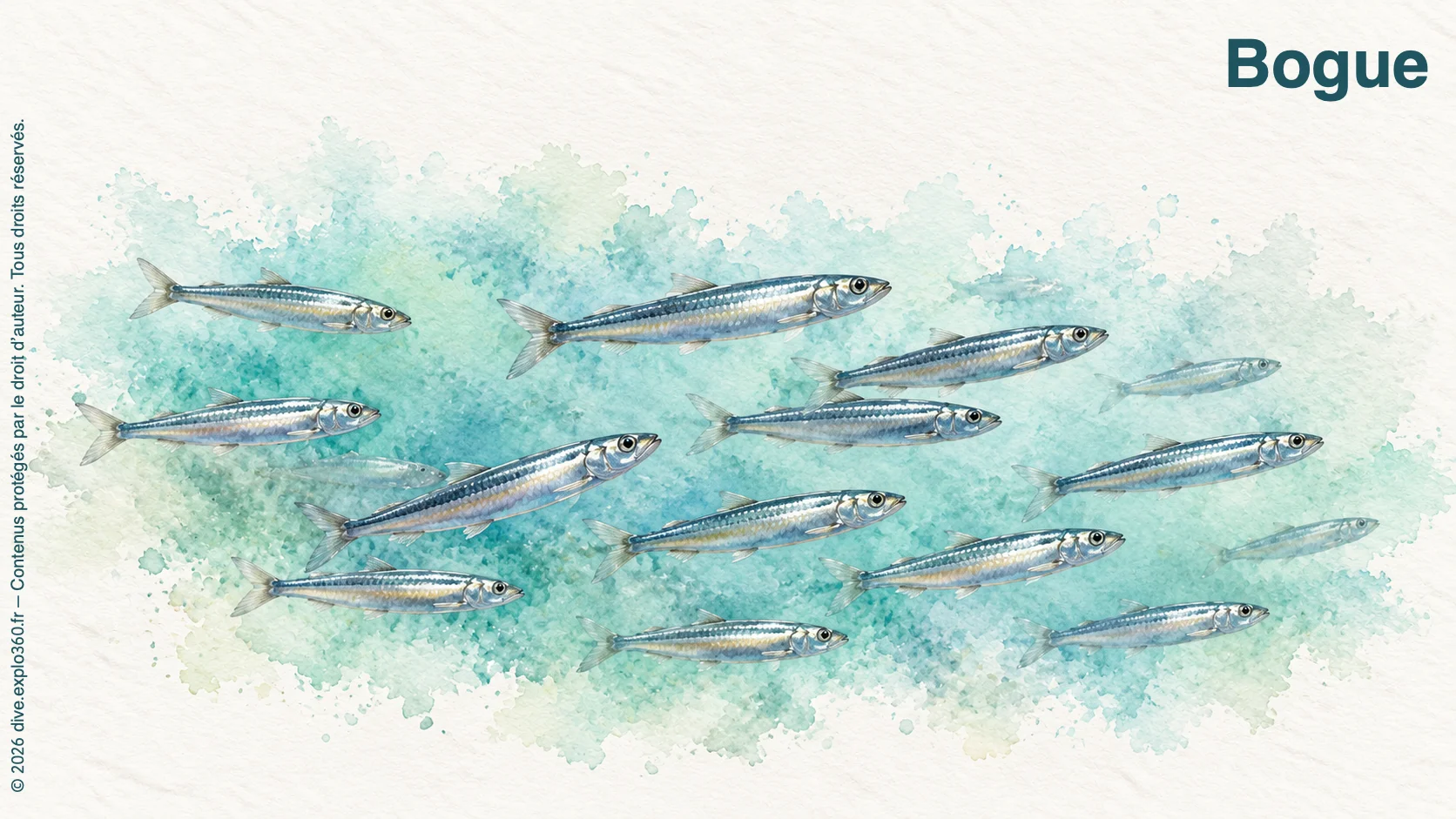
The mouth of the European anchovy (Engraulis encrasicolus) extends well behind the eye. This long opening marks a head with proportionally large eyes.
Its body is very slender, slimmer than a sardine’s. Silver sides and belly contrast with blue-green reflections on the back.
WHERE DOES IT LIVE?
Surface layers in coastal and offshore waters support anchovy schools. The species may also occupy greater depths depending on conditions. Found in the Mediterranean and north-east Atlantic, it moves partly in response to temperature changes, so an occupied area is not necessarily a permanent residence.
WHAT DOES IT EAT?
Anchovy meals consist largely of small planktonic animals, with copepods playing an important part. Stomach-content studies also record larvae, including those of molluscs and crustaceans. The precise composition depends on the available food and the population studied; a prey list from one region need not describe every shoal. To obtain this food, anchovies can capture organisms individually or filter water, using their gill rakers to help retain particles. Both methods are documented, but their relative importance varies. In some Bay of Biscay observations, individual captures predominated, whereas filtration is well established in other contexts.
GO FURTHER WITH AMIGANSEAU
Unlock the full profile
Deepen your knowledge with the exclusive chapters and interactive resources included in an AMIGANSEAU licence.
- HOW DOES IT REPRODUCE?
- OUR OBSERVATIONS
- ARTICLE
Also included in the full profile
- Advanced navigation between description, ecological context, observations and behaviour
- Interactive food chain to explore the species’ feeding relationships
- Natural history podcast and dive debrief
- Infographic and illustrated summary profile
 Understand the species