Habitat
 Depth
 Group
 Role
WHAT DOES IT LOOK LIKE?
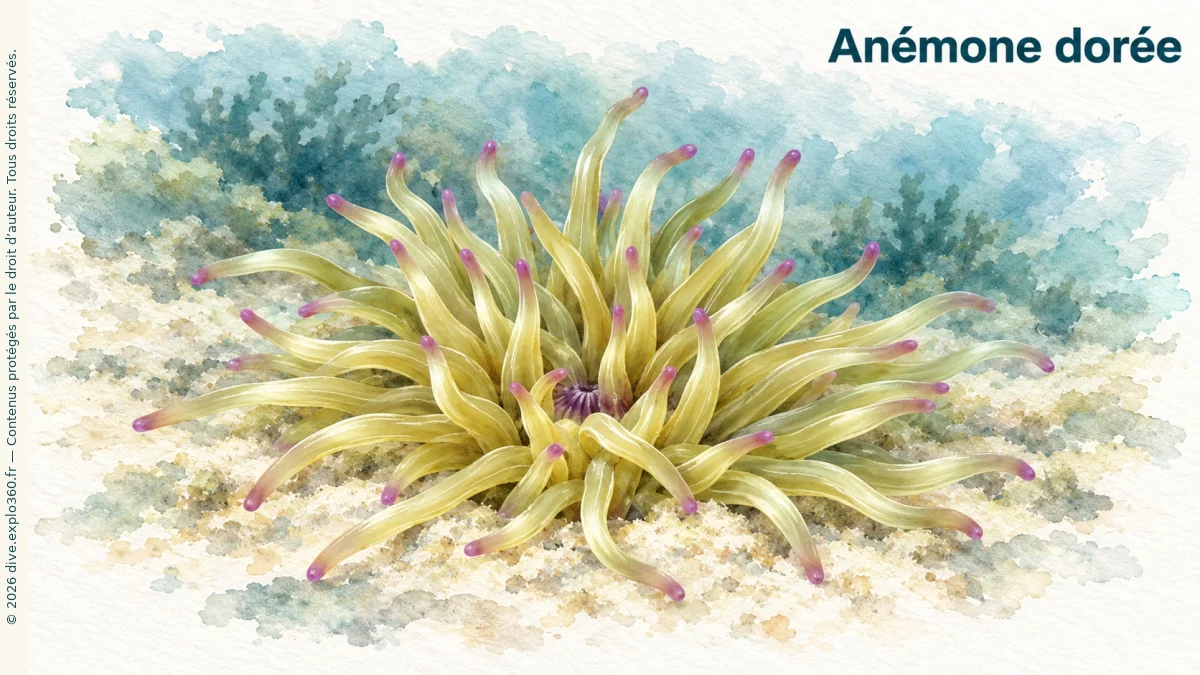
It has a column-shaped body largely concealed in sediment. The base adheres to a hard object such as a buried stone or shell. The visible part can reach around twenty-five centimetres across when expanded.
Tentacles, relatively short for this large anemone, are yellow to green or sometimes greyish, often violet-tipped. Whitish lines run along them, sometimes with breaks. The central mouth is frequently violet.
WHERE DOES IT LIVE?
It occupies Mediterranean sandy bottoms from a few metres to several tens of metres, with descriptions extending to around eighty metres. It sometimes appears simply to rest on sand while its attachment remains hidden.
This setting helps distinguish it from the often-confused Cribrinopsis crassa, which occupies rocky crevices. Golden anemone tentacles are also more slender and carry characteristic lengthwise lines. Violet tips alone therefore do not decide identity.
WHAT DOES IT EAT?
It is carnivorous. Tentacle stinging cells help catch small prey, which is then directed towards the mouth. A flower-like crown is not a plant organ but an animal feeding surface.
Associated shrimps nevertheless show that not every organism touching tentacles is necessarily eaten. Calling a shrimp prey requires observing capture rather than contact alone.
GO FURTHER WITH AMIGANSEAU
Unlock the full profile
Deepen your knowledge with the exclusive chapters and interactive resources included in an AMIGANSEAU licence.
- HOW DOES IT REPRODUCE?
- OUR OBSERVATIONS
- ARTICLE
Also included in the full profile
- Advanced navigation between description, ecological context, observations and behaviour
- Interactive food chain to explore the species’ feeding relationships