


 Habitat
 Depth
 Group
 Role
 Average size
WHAT DOES IT LOOK LIKE?
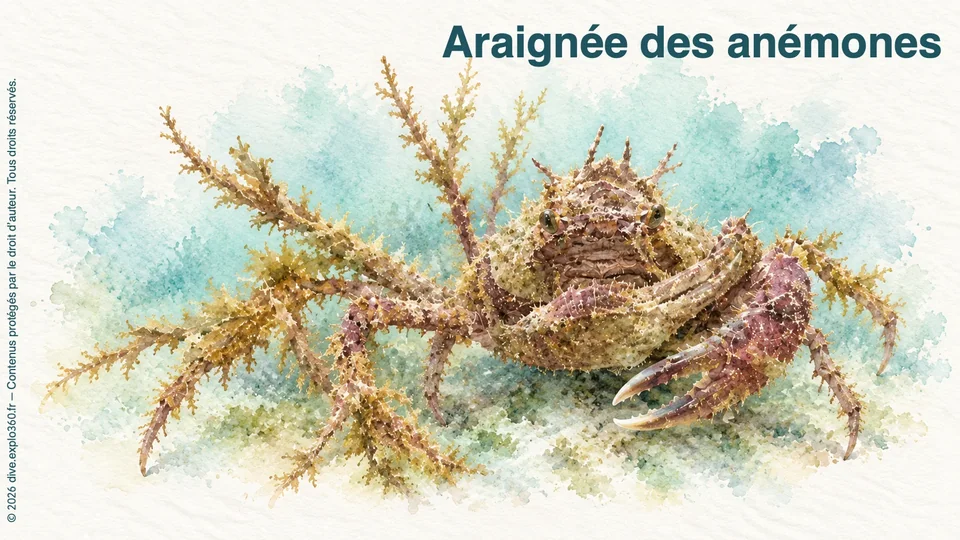
The anemone spider crab (Inachus phalangium) has very long, slender legs and a small triangular carapace. This hard shell is only about 2 cm long, measured without the legs.
Its orange to brown colours can disappear beneath algae or other material attached to the back and legs. Small hook-like projections retain this covering, blurring the outline.
WHERE DOES IT LIVE?
Among an anemone’s tentacles, the anemone spider crab occupies shelter on a scale of centimetres. The snakelocks anemone is one host it uses. This small-scale habitat mainly occurs in shallow rocky Mediterranean and eastern Atlantic areas, making anemones the main feature to look for.
WHAT DOES IT EAT?
For the anemone spider crab, wearing a piece of alga and eating it are distinct behaviours. Experiments show that choices of food and camouflage materials differ, and that some worn fragments can act as a short-term food store. Nutrition includes animal resources, organic debris and possible algal consumption. Collected material is brought towards the mouthparts.
GO FURTHER WITH AMIGANSEAU
Unlock the full profile
Deepen your knowledge with the exclusive chapters and interactive resources included in an AMIGANSEAU licence.
- HOW DOES IT REPRODUCE?
- OUR OBSERVATIONS
- ARTICLE
Also included in the full profile
- Advanced navigation between description, ecological context, observations and behaviour
- Interactive food chain to explore the species’ feeding relationships
- Natural history podcast and dive debrief
- Infographic and illustrated summary profile
 Understand the species