Habitat
 Depth
 Group
 Role
WHAT DOES IT LOOK LIKE?
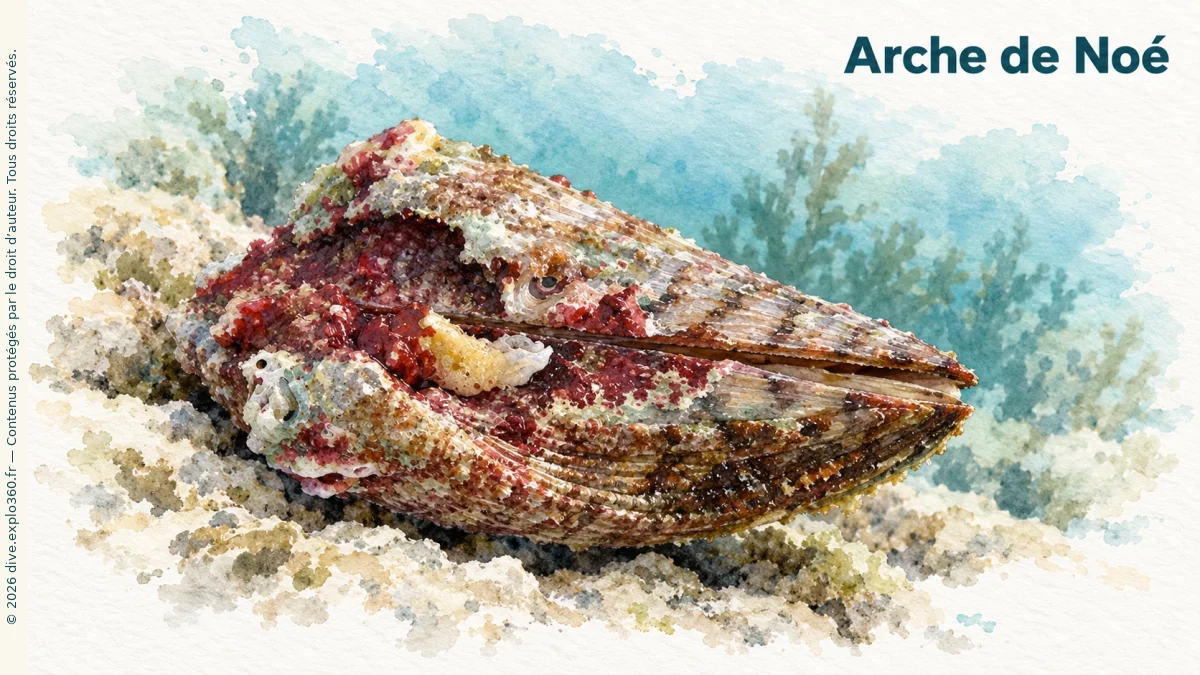
Noah’s ark has a thick, elongated, angular shell, often five to eight centimetres long. Its nearly straight hinge extends along much of the shell. Closely spaced ribs radiate across both valves.
Brown markings on a yellowish background are frequently concealed by attached organisms. The covering can make the bivalve resemble a small lump of rock. Very little of the body is visible between the valves.
WHERE DOES IT LIVE?
It attaches to stones and rocks with a byssus, a bundle of strong threads. It occupies fissures and other spaces on hard seabeds, from shallow water to around a hundred metres.
Its range includes the Mediterranean and eastern Atlantic. The valve is not cemented to the rock: threads connect the body to the support.
WHAT DOES IT EAT?
It feeds on suspended particles captured as water passes over the gills. Tiny moving cilia maintain the flow. Particles are sorted before reaching the mouth.
It has no long siphon, the tube some other bivalves use to exchange water. Circulation occurs through the opening and interior space of the shell.
GO FURTHER WITH AMIGANSEAU
Unlock the full profile
Deepen your knowledge with the exclusive chapters and interactive resources included in an AMIGANSEAU licence.
- HOW DOES IT REPRODUCE?
- OUR OBSERVATIONS
- ARTICLE
Also included in the full profile
- Advanced navigation between description, ecological context, observations and behaviour
- Interactive food chain to explore the species’ feeding relationships