Habitat
 Depth
 Group
 Role
WHAT DOES IT LOOK LIKE?
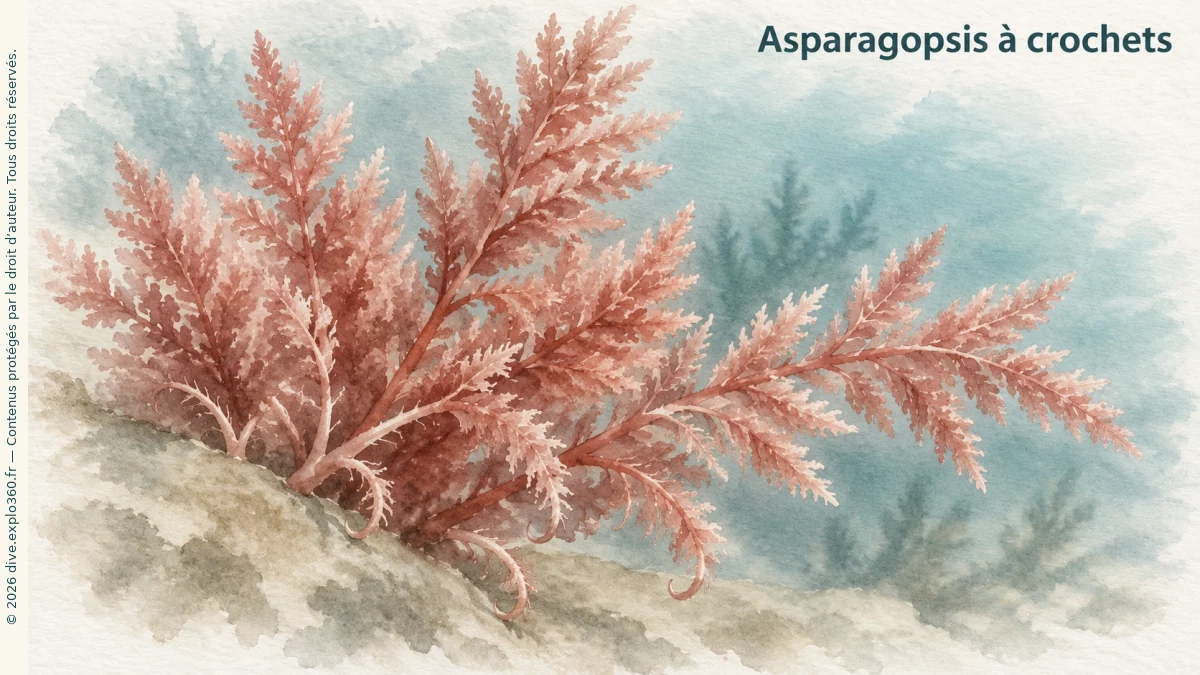
The upright form of Asparagopsis armata has pink to pinkish-red axes and many fine branchlets. Some less densely clothed branches bear recurved harpoons, attachment structures particularly useful for identification.
The thallus, the algal body, can have a pyramidal outline. Another visible generation forms small filament pompoms once described as Falkenbergia rufolanosa.
WHERE DOES IT LIVE?
It grows in lit shallow water on rocks and often epiphytically, meaning on other algae used as support. The harpoon form develops mainly in the cooler season in the western Mediterranean.
Southern Hemisphere in origin, it is introduced along French coasts.
WHAT DOES IT EAT?
Photosynthesis uses light and available carbon to produce organic matter. The thallus also absorbs dissolved nutrients.
Hooks do not catch prey. They provide mechanical contact with surfaces and can help a detached portion remain attached elsewhere.
GO FURTHER WITH AMIGANSEAU
Unlock the full profile
Deepen your knowledge with the exclusive chapters and interactive resources included in an AMIGANSEAU licence.
- HOW DOES IT REPRODUCE?
- OUR OBSERVATIONS
- ARTICLE
Also included in the full profile
- Advanced navigation between description, ecological context, observations and behaviour
- Interactive food chain to explore the species’ feeding relationships