Habitat
 Depth
 Group
 Role
WHAT DOES IT LOOK LIKE?
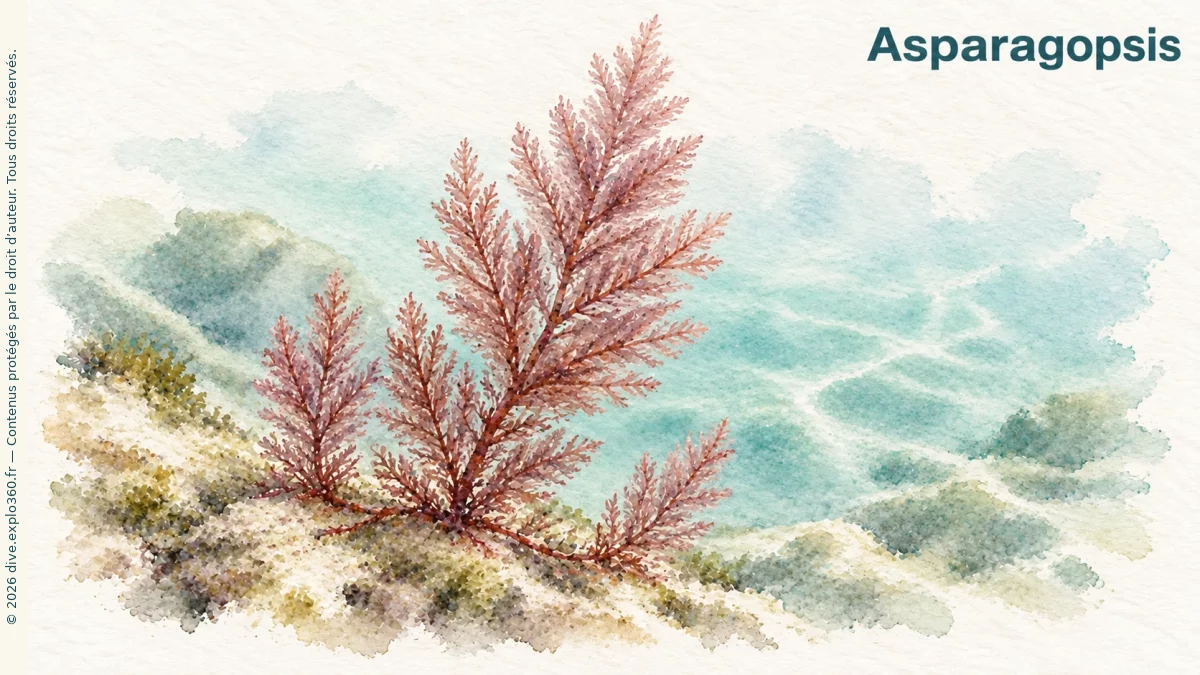
The asparagopsis seaweed develops an erect finely branched gametophyte, grey-pink to reddish-brown. Side branches on a cylindrical axis can create a pyramidal outline, denser towards the top. Stolons help attachment. The absence of harpoon-like branchlets distinguishes it from Asparagopsis armata when details are visible. Height can reach roughly 30 cm. “Red seaweed” does not require bright red colour under all conditions.
WHERE DOES IT LIVE?
French Mediterranean coasts and many warm marine regions hold documented populations. Illuminated rock is characteristic habitat. Western Mediterranean studies report occurrence from shallow water to around 30 m. Several genetic lineages have different histories and traits. A photographed tuft alone does not reveal a population’s geographical origin or genetic identity.
WHAT DOES IT EAT?
Photosynthesis uses light energy to produce organic matter, with dissolved mineral resources supporting growth. Branching is not a hunting apparatus. Light, nutrients and water movement contribute to ecological context. Producer status is retained without adding Mediterranean food links from animals used in aquaria elsewhere. Experimental findings keep their local scope and methodological context.
GO FURTHER WITH AMIGANSEAU
Unlock the full profile
Deepen your knowledge with the exclusive chapters and interactive resources included in an AMIGANSEAU licence.
- HOW DOES IT REPRODUCE?
- OUR OBSERVATIONS
- ARTICLE
Also included in the full profile
- Advanced navigation between description, ecological context, observations and behaviour
- Interactive food chain to explore the species’ feeding relationships