Habitat
 Depth
 Group
 Role
WHAT DOES IT LOOK LIKE?
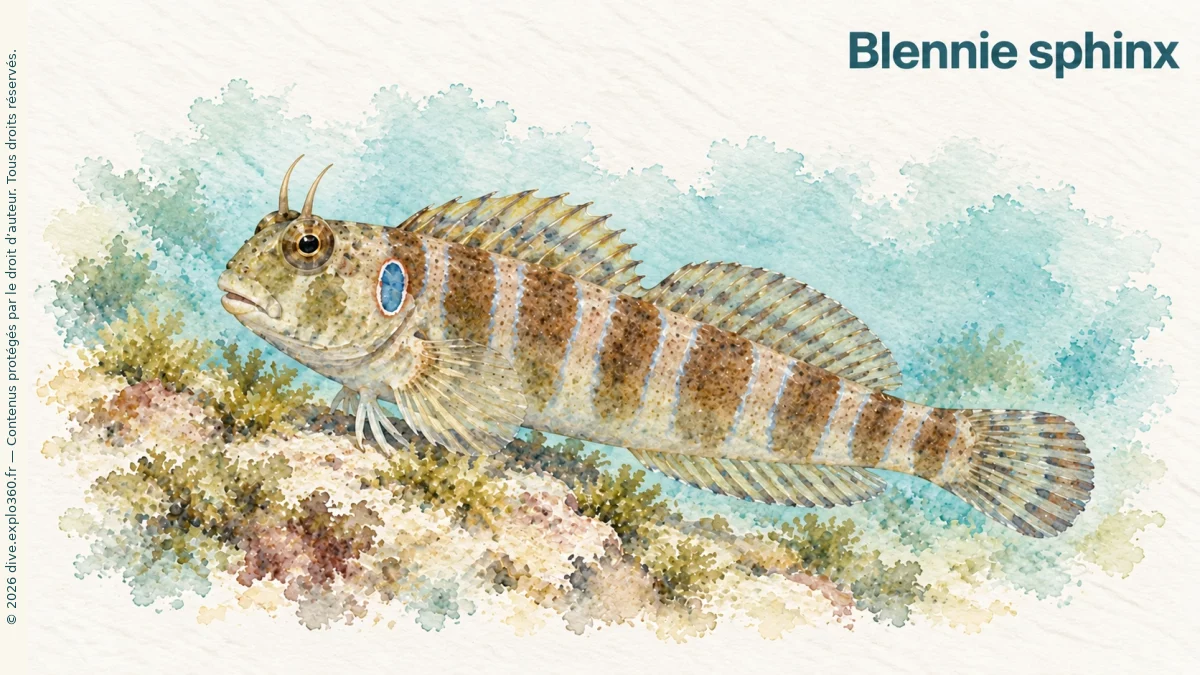
The sphinx blenny has an elongated compressed body, steep forehead and two short simple supraorbital cirri. Beige, yellow-brown or greenish colouring carries darker bars edged blue or white. Males show a bluish ocellus rimmed red behind the eye, together with blue cheek markings. The long dorsal has a pronounced notch between its portions; its anterior part is more developed in males.
WHERE DOES IT LIVE?
The species occupies shallow rocky Mediterranean and Black Sea habitats. Algal subhorizontal surfaces and crevices in wave-washed areas are especially useful. DORIS mainly describes 0–3 or 4 m. Very shallow water can therefore support detailed natural-history watching. Habitat complexity occurs at the scale of shelter openings and rock cover.
WHAT DOES IT EAT?
The diet combines algae with small animals, consistent with omnivory. The fish uses living substrate cover and makes brief excursions followed by returns to holes. A witnessed capture should precede any precise food identification: a head directed towards rock alone does not reveal what is being eaten.
GO FURTHER WITH AMIGANSEAU
Unlock the full profile
Deepen your knowledge with the exclusive chapters and interactive resources included in an AMIGANSEAU licence.
- HOW DOES IT REPRODUCE?
- OUR OBSERVATIONS
- ARTICLE
Also included in the full profile
- Advanced navigation between description, ecological context, observations and behaviour
- Interactive food chain to explore the species’ feeding relationships