DIVE.EXPLO360.FRObserve, understand, share
Diver services

You can also access AMIGANSEAU diver services. Sign in to these services with your email address and pairing code.

trouve-MOIIdentify an encounterExplorariumKeep and share your dive memories
ShopAMIGANSEAU ACCESS ↗
Partners and information

Contact us

Verification code

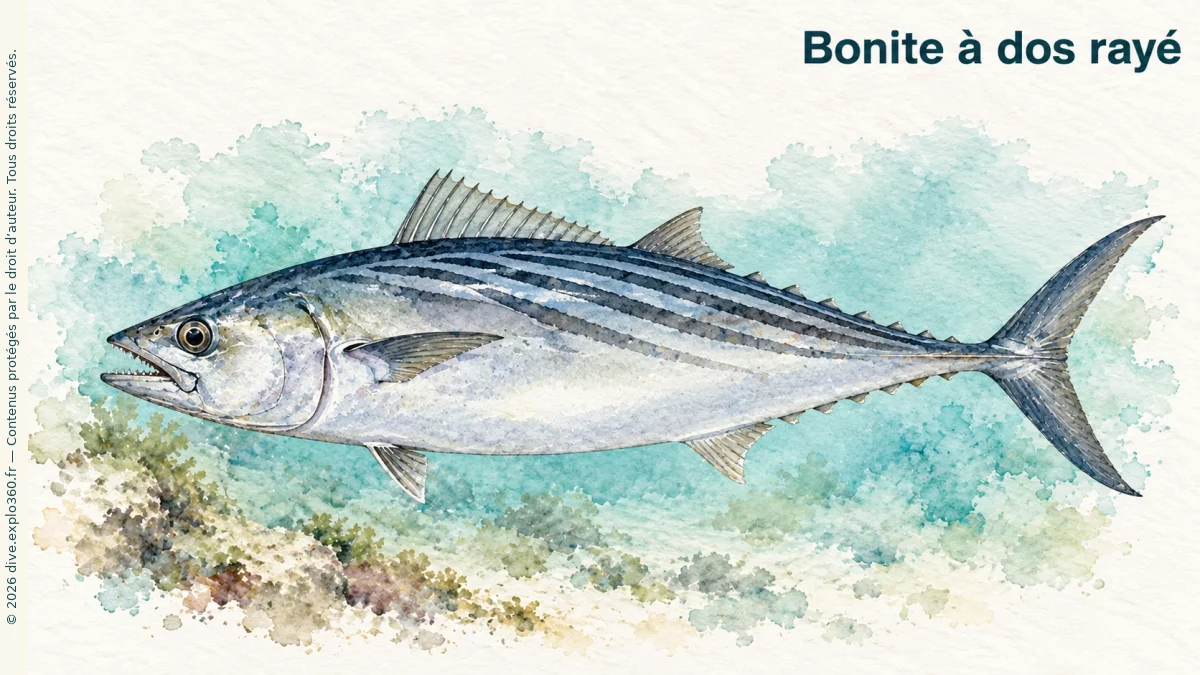
Atlantic bonito

Distribution : Atlantic and Mediterranean including the Black Sea. DORIS describes near-surface encounters; FishBase also reports 80–200 m. The combined 0–200 m interval does not imply uniform frequency.

Atlantic bonito is read through body lines: spindle shape, forked tail and upper stripes. Marking position is more informative than a vague small-tuna label and keeps observations comparable across related species.

Habitat of Atlantic bonito Habitat
Open water
Depth range of Atlantic bonito Depth
0-200 m
Biological group of Atlantic bonito Group
Ecological role of Atlantic bonito Role
Predator

📏 Size

About 50 cm; maximum 91.4 cm in DORIS

WHAT DOES IT LOOK LIKE?

The Atlantic bonito combines a compressed spindle body with an elongated head and widely opening mouth. Five to eleven oblique bands mark the dark blue back, while the belly stays pale and plain. The dorsals are closely spaced and the first has a relatively straight edge. The narrow caudal peduncle carries a keel and finlets: seven to nine above and six to eight below in DORIS, before a deeply forked tail.

WHERE DOES IT LIVE?

The distribution includes Atlantic and Mediterranean waters, including the Black Sea. Neritic waters above the continental shelf are important. Seasonal movement brings groups near coasts, but surface sightings do not exclude deeper use. A combined interval records occurrence without implying constant frequency at every site.

WHAT DOES IT EAT?

Diet is primarily fish, including sardines and anchovies. Cephalopods and pelagic crustaceans broaden resources. Mouth structure and swimming support capture of mobile prey. Shoals may mingle with other open-water species, yet association cannot name every neighbour as predator or prey. Shared movement and witnessed capture are different observations.

GO FURTHER WITH AMIGANSEAU

Unlock the full profile

Deepen your knowledge with the exclusive chapters and interactive resources included in an AMIGANSEAU licence.

Choose my licence
  • HOW DOES IT REPRODUCE?
  • OUR OBSERVATIONS
  • ARTICLE

Also included in the full profile

  • Advanced navigation between description, ecological context, observations and behaviour
  • Interactive food chain to explore the species’ feeding relationships
An active licence gives access to enriched profiles and AMIGANSEAU exploration tools.
Atlantic bonito

🧠 Understand the species

What is this species’ ecological role?

AMIGANSEAU Explorer Premium

Access enriched species profiles with advanced content (audio, infographics and detailed articles).

Explore all species easily through a single interface.

Enjoy a smooth, fast learning experience suited to every level.

🔒 The full profile is available with a paid subscription only.

Discover licences

POURSUIVRE L’EXPLORATION

Explore further

ArticleSCHOOLS OF FISHRead the article →ArticleWHAT IF IT ALL HAPPENED UNDERWATER?Read the article →ArticleMarine Life, a World of RolesRead the article →