


 Habitat
 Depth
 Group
 Role
 Average size
 Good to know
WHAT DOES IT LOOK LIKE?
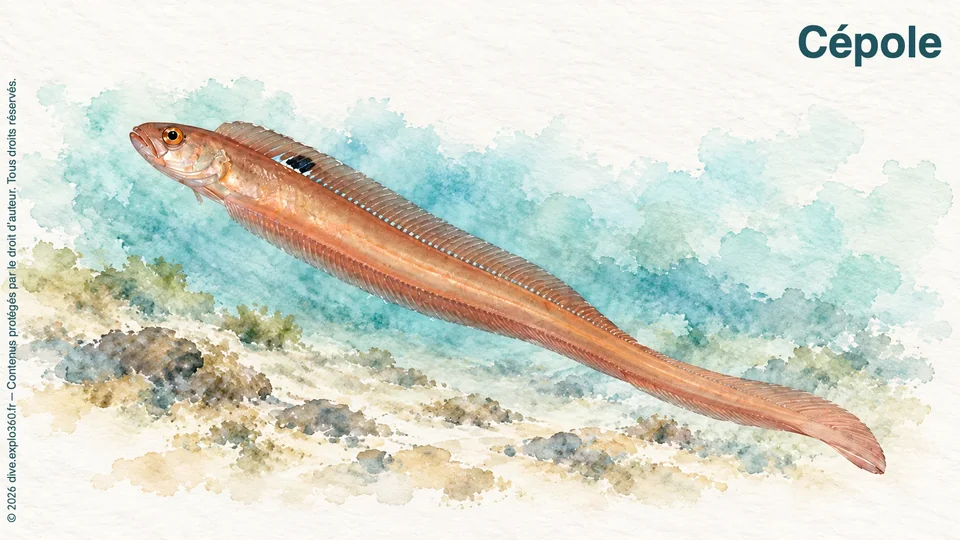
The red bandfish (Cepola macrophthalma) has a large mouth that slants upwards. Its body is a long ribbon, flattened from side to side and gradually narrowing towards the tail.
The fins along the back and underside follow almost the entire length. Pink to reddish orange colouring and rippling body movements give this fish a flowing appearance. The largest specimens reach 80 cm.
WHERE DOES IT LIVE?
The red bandfish mainly inhabits soft sandy and muddy seabeds. It is reported from depths of 15 to 400 metres and lives notably in the Mediterranean and eastern Atlantic.
The red bandfish digs a vertical burrow in the sediment and can retreat into it quickly. It emerges to swim above the seabed, sometimes several body lengths from its shelter, but remains closely associated with soft bottoms.
WHAT DOES IT EAT?
The red bandfish feeds mainly on small planktonic crustaceans and chaetognaths, also known as arrow worms. It captures them in the water while swimming near its burrow or above the seabed.
GO FURTHER WITH AMIGANSEAU
Unlock the full profile
Deepen your knowledge with the exclusive chapters and interactive resources included in an AMIGANSEAU licence.
- HOW DOES IT REPRODUCE?
- OUR OBSERVATIONS
- ARTICLE
Also included in the full profile
- Advanced navigation between description, ecological context, observations and behaviour
- Interactive food chain to explore the species’ feeding relationships
- Infographic and illustrated summary profile
 Understand the species