Habitat
 Depth
 Group
 Role
WHAT DOES IT LOOK LIKE?
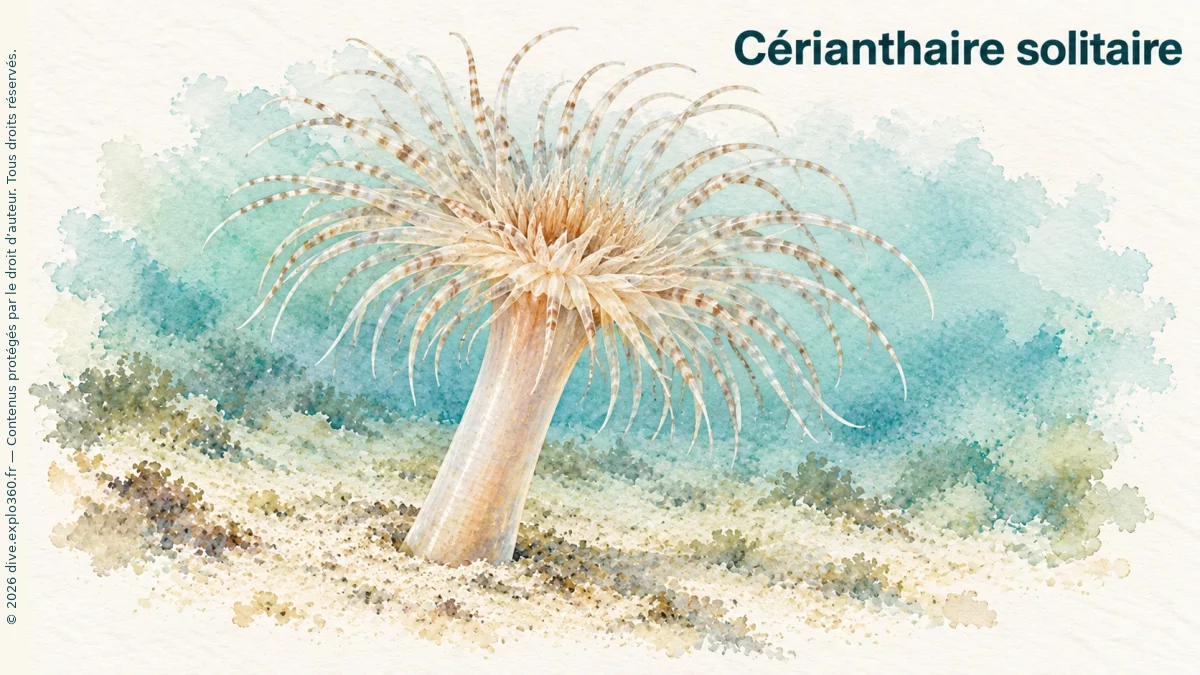
The solitary tube anemone has a smooth slender pale to translucent column. Long tapering, often banded marginal tentacles form several rows outside short labial tentacles. Around 90–120 outer tentacles form three tiers. Their crown can reach 30 cm across, while the elongated body can reach 40 cm when extended. Tips lack both corallimorph balls and octocoral feathering.
WHERE DOES IT LIVE?
The thin mucus tube remains mainly buried in calm sandy to muddy sediment, within DORIS’s reported 2–50 m range. Mediterranean and Black Sea occurrence is documented, alongside some Atlantic stations such as the Azores. ATLASea lists a Thau specimen collected in June 2026. This local evidence does not make the species common along every French coast.
WHAT DOES IT EAT?
Small suspended organisms provide food. Marginal tentacles intercept resources, with stinging cells and tentacle movement helping capture and transfer them to the mouth. Feeding remains predatory near the bottom. A fully expanded crown proves neither an ongoing capture nor a feeding rate measurable from a photograph.
GO FURTHER WITH AMIGANSEAU
Unlock the full profile
Deepen your knowledge with the exclusive chapters and interactive resources included in an AMIGANSEAU licence.
- HOW DOES IT REPRODUCE?
- OUR OBSERVATIONS
- ARTICLE
Also included in the full profile
- Advanced navigation between description, ecological context, observations and behaviour
- Interactive food chain to explore the species’ feeding relationships