Habitat
 Depth
 Group
 Role
WHAT DOES IT LOOK LIKE?
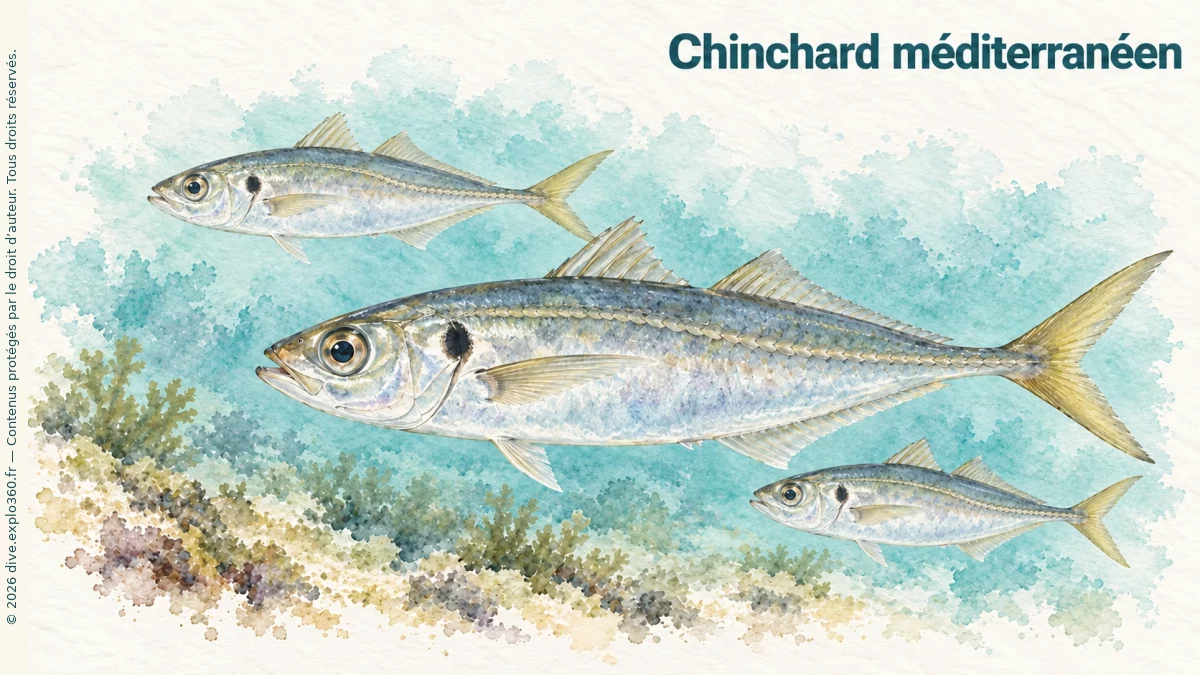
The Mediterranean horse mackerel has a slim compressed spindle body, often around thirty centimetres in DORIS. A dark opercular spot and often yellowish forked tail accompany two dorsal portions. Scutes emphasise the main lateral line, which bends at midbody before a straighter posterior section. The accessory line near the back ends around the beginning of the second dorsal.
WHERE DOES IT LIVE?
Shoaling movements occur in the Mediterranean, Black Sea and eastern Atlantic. Both near-bottom and open-water positions are used. DORIS gives 5–250 m with deeper records too. Winter offshore movement towards depth is a broad pattern rather than a rigid rule for every shoal. Local conditions and growth stage influence detectability.
WHAT DOES IT EAT?
Adults consume small fish, including sardines and anchovies, and crustaceans. Young mainly use small crustacean prey. Resource changes accompany growth. Neighbours in a sequence do not establish diet: pursuit, capture and digestive analyses provide different evidence from mere co-occurrence.
GO FURTHER WITH AMIGANSEAU
Unlock the full profile
Deepen your knowledge with the exclusive chapters and interactive resources included in an AMIGANSEAU licence.
- HOW DOES IT REPRODUCE?
- OUR OBSERVATIONS
- ARTICLE
Also included in the full profile
- Advanced navigation between description, ecological context, observations and behaviour
- Interactive food chain to explore the species’ feeding relationships