Partners and information

Contact us

Verification code

Powder blue tang

Distribution : Maldives and tropical Indian Ocean. Indian Ocean species; no editorial extension to the Pacific, Raja Ampat or Halmahera from a mention of Indonesia alone.

In the Maldives, a guide gives this blue fish the name Noo kaalhu. Farther north, in the Lakshadweep islands, fishers use other names. On Maldivian reefs, a group of these fish rarely goes unnoticed. Small damselfish each defend their own patch of algae, but when the visitors arrive together, there are too many to chase off one by one.

Images being acquired · Your video or photos here

Habitat of Powder blue tang Habitat
Coral reef, Rocky habitat
Depth range of Powder blue tang Depth
0-25 m
Biological group of Powder blue tang Group
Ecological role of Powder blue tang Role
Herbivore, Predator

Size

Often around 20 cm; reported maximum 54 cm

Precautions

A sharp blade, often called a scalpel, lies on each side of the tail base. A tail flick can cut a hand. Do not try to grasp the fish or corner it against the reef.

WHAT DOES IT LOOK LIKE?

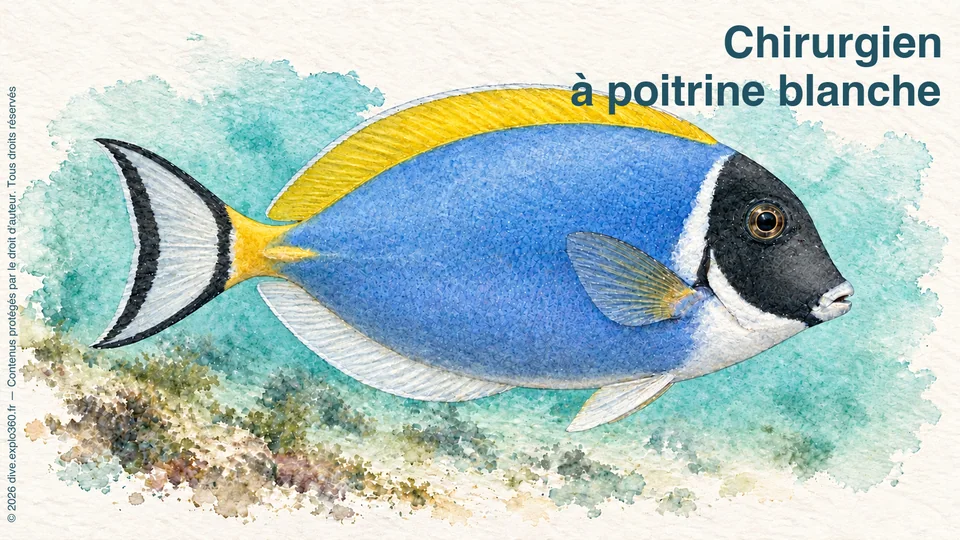
The powderblue surgeonfish (Acanthurus leucosternon) has a blue body, a yellow dorsal fin, a black head and a white chest. Its body is deep and flattened from side to side. Its crescent-shaped tail has both white and dark markings, and there is a sharp spine on each side at the base of the tail.

WHERE DOES IT LIVE?

It lives in the Indian Ocean, from East Africa to western Indonesia, including the Maldives. It inhabits reef flats, the shallow, level parts of a reef, and upper outer slopes, generally down to 25 metres.

WHAT DOES IT EAT?

The powder blue tang mainly grazes on algae attached to reef surfaces, taking small bites with its narrow mouth. It may also eat small gastropods, crustaceans and eggs. Several individuals sometimes feed together in the same part of the reef.

GO FURTHER WITH AMIGANSEAU

Unlock the full profile

Deepen your knowledge with the exclusive chapters and interactive resources included in an AMIGANSEAU licence.

Choose my licence
  • HOW DOES IT REPRODUCE?
  • OUR OBSERVATIONS
  • ARTICLE

Also included in the full profile

  • Advanced navigation between description, ecological context, observations and behaviour
  • Interactive food chain to explore the species’ feeding relationships
An active licence gives access to enriched profiles and AMIGANSEAU exploration tools.
Powder blue tang

Understand the species

What is this species’ ecological role?

AMIGANSEAU Explorer Premium

Access enriched species profiles with advanced content (audio, infographics and detailed articles).

Explore all species easily through a single interface.

Enjoy a smooth, fast learning experience suited to every level.

🔒 The full profile is available with a paid subscription only.

Discover licences

POURSUIVRE L’EXPLORATION

Explore further

ArticleWhat marine animals do and why it mattersRead the article →ArticlePHYLA WITHOUT THE FUSSRead the article →