Partners and information

Contact us

Verification code

Desjardin’s sailfin tang

Distribution : Found in the Maldives and Indian Ocean. It also occurs in the Red Sea.

Born in Mauritius in 1799, Julien François Desjardins was among the naturalists documenting Indian Ocean wildlife during the nineteenth century. He assembled a collection of fish presented to the Zoological Society of London, including the specimen used by Edward Turner Bennett to describe this sailfin tang in 1836. The fish's name preserves the memory of a Mauritian naturalist and the scientific exchanges linking the Mascarene Islands with Europe.

Images being acquired · Your video or photos here

Habitat of Desjardin’s sailfin tang Habitat
Coral reef
Depth range of Desjardin’s sailfin tang Depth
1-30 m
Biological group of Desjardin’s sailfin tang Group
Ecological role of Desjardin’s sailfin tang Role
Herbivore

Size

Up to 40 cm

Precautions

A sharp blade, often called a scalpel, lies on each side of the tail base. A tail flick can cut a hand. Do not try to grasp the fish or corner it against the reef.

WHAT DOES IT LOOK LIKE?

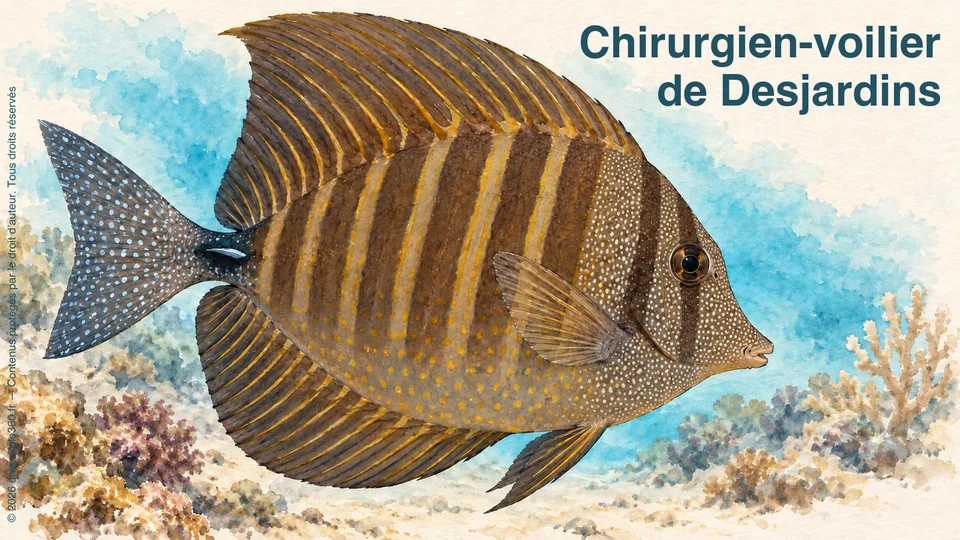
Desjardin’s sailfin tang (Zebrasoma desjardinii) has pale spots on its tail and dark bands alongside ochre lines on its body. The lines break up into spots towards the belly. Its large fins look like sails when spread. A spine folds flat on each side at the base of the tail. The fish reaches 40 cm.

WHERE DOES IT LIVE?

It lives in the Indian Ocean and Red Sea. In the Maldives it occurs in lagoons, outer reefs and coral habitats.

Juveniles (young animals) stay near corals in sheltered places, sometimes in turbid water. It is often found in the upper 30 m, but may also occur deeper.

WHAT DOES IT EAT?

Desjardin’s sailfin tang feeds mainly on fleshy algae taken from rocky and coral reef surfaces. It may also swallow small organisms living among the algae. It grazes during the day, alone or in groups. When large herbivores pass through an area defended by other fish, it may take advantage of their passage to reach the algae.

GO FURTHER WITH AMIGANSEAU

Unlock the full profile

Deepen your knowledge with the exclusive chapters and interactive resources included in an AMIGANSEAU licence.

Choose my licence
  • HOW DOES IT REPRODUCE?
  • OUR OBSERVATIONS
  • ARTICLE

Also included in the full profile

  • Advanced navigation between description, ecological context, observations and behaviour
  • Interactive food chain to explore the species’ feeding relationships
An active licence gives access to enriched profiles and AMIGANSEAU exploration tools.
Desjardin’s sailfin tang

Understand the species

What is this species’ ecological role?

AMIGANSEAU Explorer Premium

Access enriched species profiles with advanced content (audio, infographics and detailed articles).

Explore all species easily through a single interface.

Enjoy a smooth, fast learning experience suited to every level.

🔒 The full profile is available with a paid subscription only.

Discover licences