Habitat
 Depth
 Group
 Role
WHAT DOES IT LOOK LIKE?
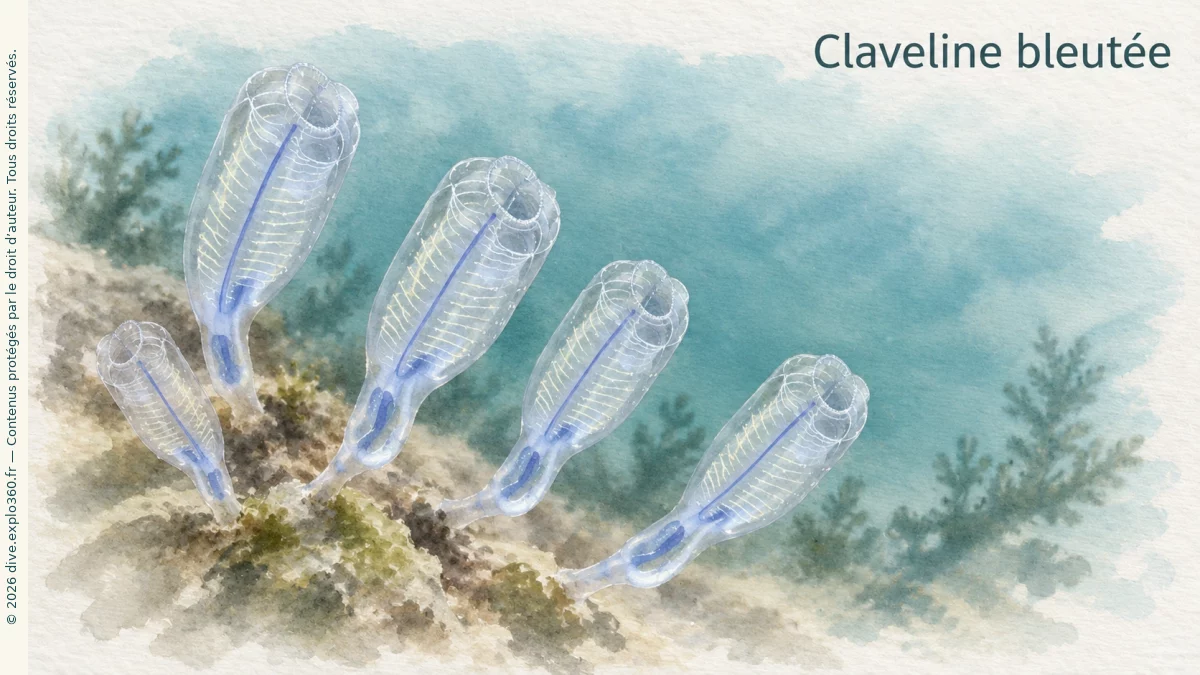
The blue-tinted sea squirt has a very transparent tunic, the outer covering. The body stands on a stalk and bears two close, prominent siphons, the water inlet and outlet. Pale stripes of the branchial basket are visible.
A purplish-blue line marks the endostyle, the groove producing mucus for food capture. A short intestinal loop and other structures beneath the filter can also be bluish. These anatomical markings are more useful than an overall blue reflection.
WHERE DOES IT LIVE?
It attaches to rocks, coralligenous formations and sometimes organisms such as gorgonians. It occurs along French Mediterranean coasts, notably on rocky sites beyond the very shallowest water.
Zooids, the colony’s individual units, may stand apart or form a cluster. Fine stolons, creeping basal extensions, link them without necessarily forming a large common mass.
WHAT DOES IT EAT?
Water enters the oral siphon and crosses the branchial basket, a filter pierced by slits. A mucus net retains microscopic food and conveys it towards the digestive tract. Cilia, fine moving cell projections, help transport it.
Filtered water reaches the cavity surrounding the branchial basket and leaves through the exhalant siphon. Digestive waste also enters this outgoing route, but after a separate journey through stomach and intestine.
GO FURTHER WITH AMIGANSEAU
Unlock the full profile
Deepen your knowledge with the exclusive chapters and interactive resources included in an AMIGANSEAU licence.
- HOW DOES IT REPRODUCE?
- OUR OBSERVATIONS
- ARTICLE
Also included in the full profile
- Advanced navigation between description, ecological context, observations and behaviour
- Interactive food chain to explore the species’ feeding relationships