Habitat
 Depth
 Group
 Role
WHAT DOES IT LOOK LIKE?
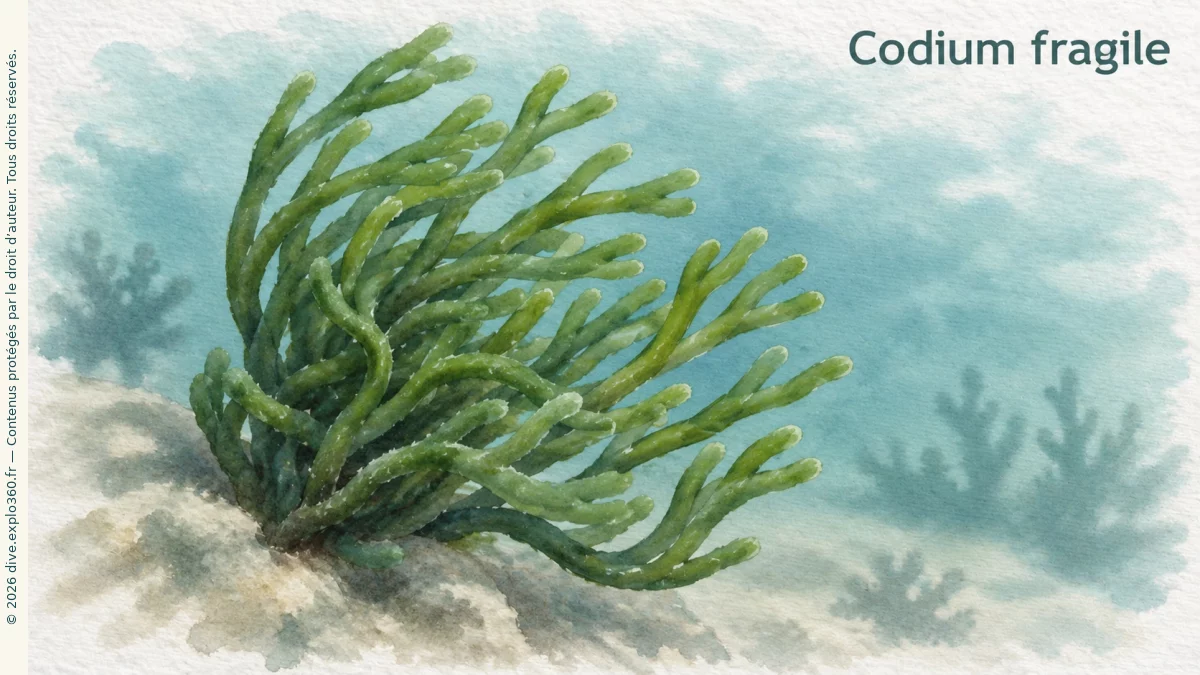
The thallus, the algal body, is upright and green with cylindrical, often repeatedly forking branches. Numerous hairs can make the surface look hairy. A base holds it to the surface.
Utricles, the swollen filament tips composing the exterior, bear a small point called a mucro. This microscopic feature matters when comparing similarly shaped codiums.
WHERE DOES IT LIVE?
It occupies hard natural or artificial shallow-water surfaces and some coastal lagoons. Its origin lies in the Pacific; the introduced form is widely documented in the Mediterranean.
This does not justify calling every branched codium on rock invasive. Similar species must be separated before interpreting records.
WHAT DOES IT EAT?
Photosynthesis uses light to produce organic matter from available carbon in water. Dissolved nutrients supply other elements needed for growth.
The body is siphonous: a filament network contains many nuclei in shared contents without the regular cross-walls of ordinary plant tissue. Utricles form the green outer layer.
GO FURTHER WITH AMIGANSEAU
Unlock the full profile
Deepen your knowledge with the exclusive chapters and interactive resources included in an AMIGANSEAU licence.
- HOW DOES IT REPRODUCE?
- OUR OBSERVATIONS
- ARTICLE
Also included in the full profile
- Advanced navigation between description, ecological context, observations and behaviour
- Interactive food chain to explore the species’ feeding relationships