Habitat
 Depth
 Group
 Role
WHAT DOES IT LOOK LIKE?
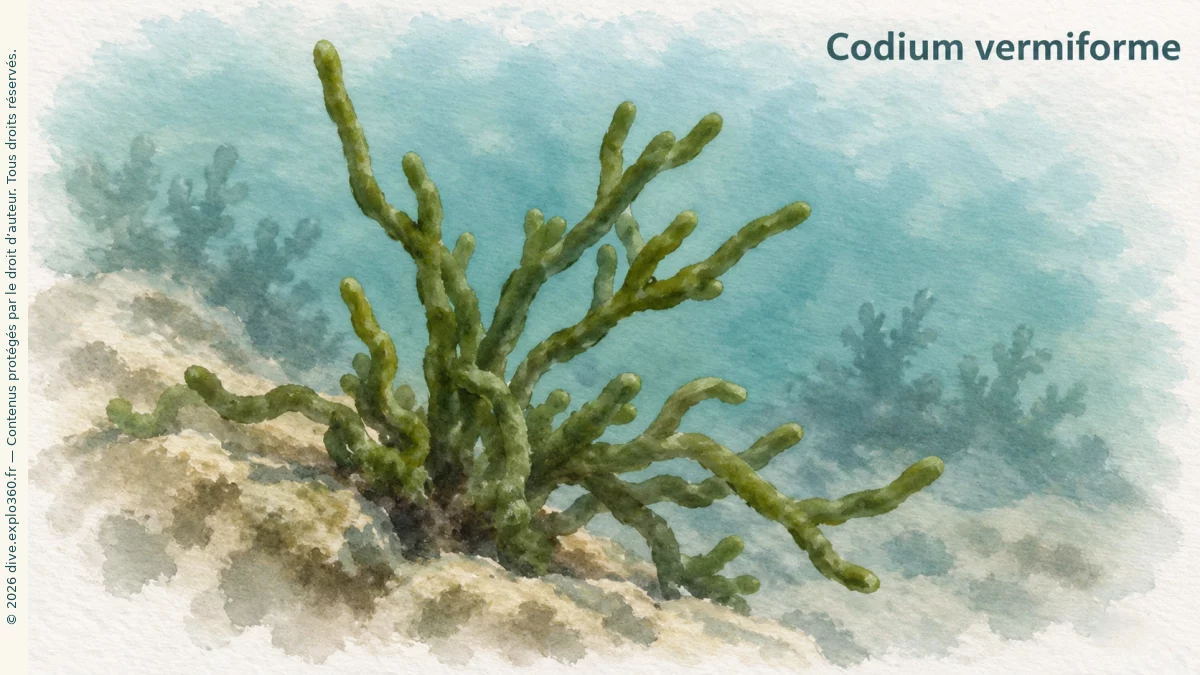
The wormlike codium forms upright thalli, the algal bodies, with cylindrical green branches and often irregular divisions. Small side shoots can complicate the forks. Numerous hairs sometimes cover the surface.
Utricles, the swollen ends of superficial filaments, have rounded or slightly truncated tips. They lack the mucro, the small point used to recognise Codium fragile.
WHERE DOES IT LIVE?
It attaches to Mediterranean hard surfaces and is recorded along French coasts, often within mixed algal communities.
Follow branches to their base when describing a tuft rather than combining neighbouring parts. Depth and exposure supplement records but do not replace anatomical identification.
WHAT DOES IT EAT?
Photosynthesis produces organic matter using light energy and carbon available in water. The alga also absorbs mineral nutrients needed for growth.
Its body is siphonous: filaments contain many nuclei within shared contents, without regular cross-walls. The internal network and green outer ends form a continuous arrangement.
GO FURTHER WITH AMIGANSEAU
Unlock the full profile
Deepen your knowledge with the exclusive chapters and interactive resources included in an AMIGANSEAU licence.
- HOW DOES IT REPRODUCE?
- OUR OBSERVATIONS
- ARTICLE
Also included in the full profile
- Advanced navigation between description, ecological context, observations and behaviour
- Interactive food chain to explore the species’ feeding relationships