Habitat
 Depth
 Group
 Role
WHAT DOES IT LOOK LIKE?
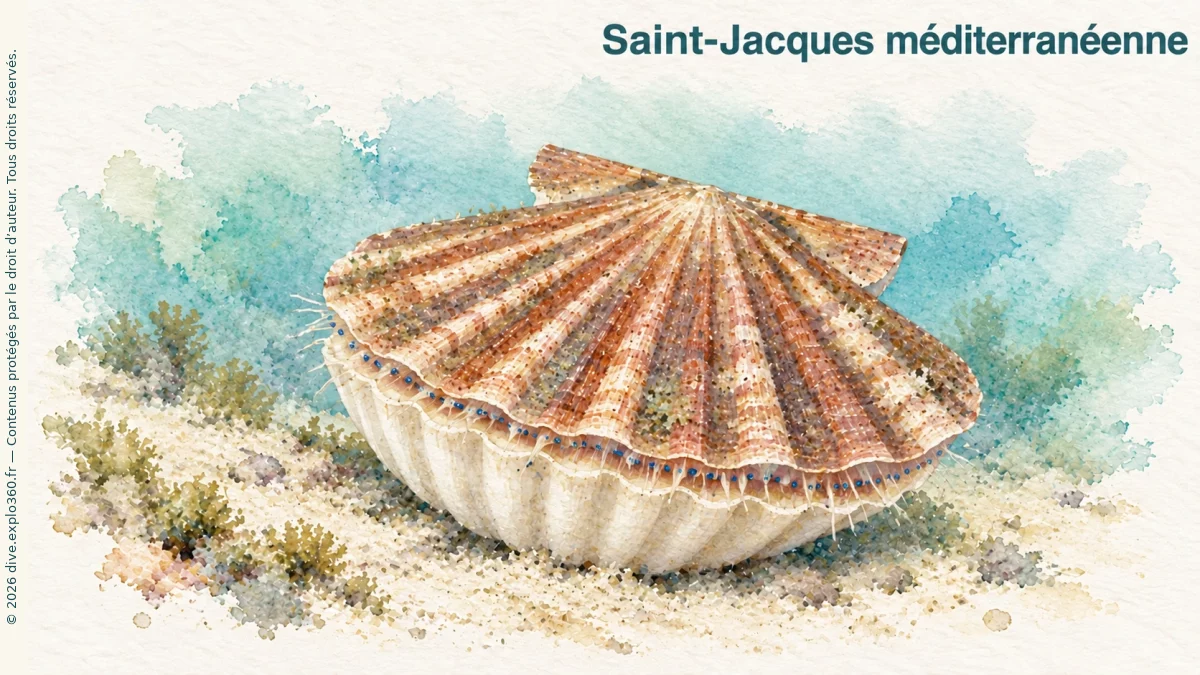
The Mediterranean scallop has unequal valves: the creamy convex right valve supports the animal, while the left is flat and usually brown. Hinge ears are equal. Fourteen to sixteen angular radiating ribs structure the shell. Numerous eyes and sensory tentacles line the mantle. Maximum length is around fifteen centimetres.
WHERE DOES IT LIVE?
It lives on loose Mediterranean seabeds of sand, mud and shell sand, which contains broken shells. It is usually found at depths of 15–50 metres. The shell rests on the bottom, where water brings food within reach.
WHAT DOES IT EAT?
It feeds by filtering water. It retains organic particles, small fragments from living things, and plankton, organisms drifting in the water. Microscopic algae are an important part of this food. Water therefore brings a meal to the animal resting on the seabed.
GO FURTHER WITH AMIGANSEAU
Unlock the full profile
Deepen your knowledge with the exclusive chapters and interactive resources included in an AMIGANSEAU licence.
- HOW DOES IT REPRODUCE?
- OUR OBSERVATIONS
- ARTICLE
Also included in the full profile
- Advanced navigation between description, ecological context, observations and behaviour
- Interactive food chain to explore the species’ feeding relationships