Habitat
 Depth
 Group
 Role
WHAT DOES IT LOOK LIKE?
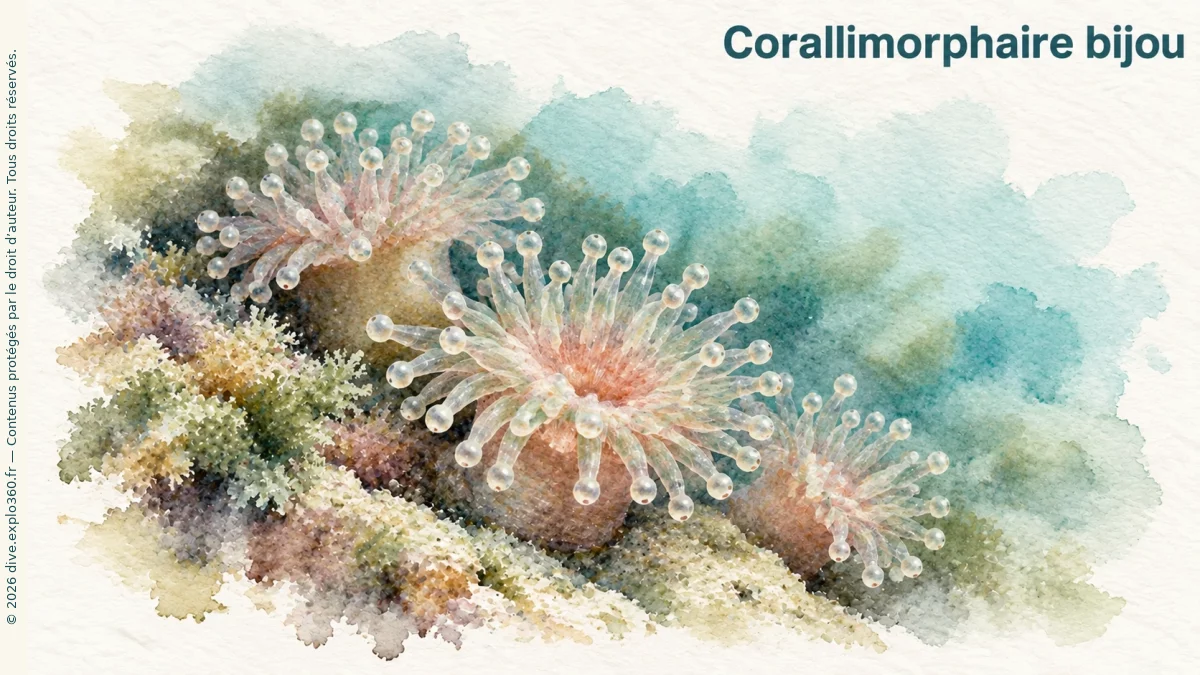
The jewel anemone has a short soft column and an oral disc about 10–15 mm across. Numerous tentacles form concentric rows and terminate in rounded, often pale acrospheres. Pink, orange and green are among its variable colours. It lacks a solitary hard coral’s limestone cup. Terminal swellings, small size and soft body together provide stronger evidence than hue alone.
WHERE DOES IT LIVE?
Shaded rock, walls and sometimes wrecks provide Mediterranean and northeast Atlantic habitat. Moving water renews small food resources. Its depth varies between regions; in the Mediterranean, it lives down to 100 m. Deep records do not exclude shallow overhangs. Depth, orientation and shade should be recorded separately when describing a station.
WHAT DOES IT EAT?
Tentacles use stinging cells to capture animal plankton, then transfer prey towards the central mouth. The animal intercepts waterborne resources rather than pursuing them through open water. Neither exact diet nor capture intensity can be inferred from colour or one photograph.
GO FURTHER WITH AMIGANSEAU
Unlock the full profile
Deepen your knowledge with the exclusive chapters and interactive resources included in an AMIGANSEAU licence.
- HOW DOES IT REPRODUCE?
- OUR OBSERVATIONS
- ARTICLE
Also included in the full profile
- Advanced navigation between description, ecological context, observations and behaviour
- Interactive food chain to explore the species’ feeding relationships