


 Habitat
 Depth
 Group
 Role
 Average size
WHAT DOES IT LOOK LIKE?
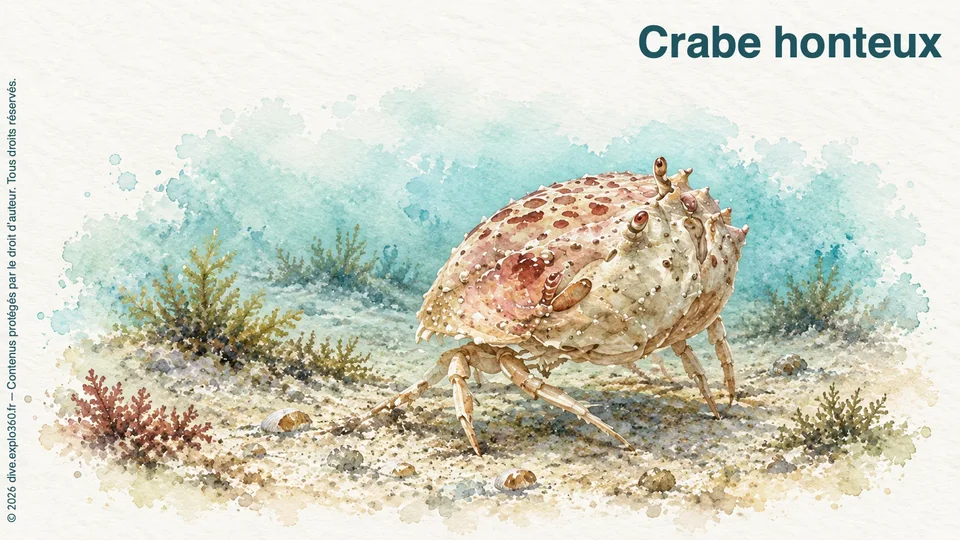
The shamefaced crab (Calappa granulata) has a broad, domed shell with rows of small reddish bumps against a pale pink to yellowish background. The bumps give the shell a grainy appearance. Towards the rear, the shell widens and has toothed edges.
The two claws are bulky but flattened and fold against the front of the body. Their outline continues the curve of the shell and partly conceals the head, giving the whole crab a compact silhouette.
WHERE DOES IT LIVE?
It is found in the Mediterranean Sea and nearby Atlantic, mainly on sandy or muddy seabeds. It often lives partly buried in the sediment, allowing it to protect itself and remain inconspicuous. It occurs from shallow water to more than a hundred metres deep.
WHAT DOES IT EAT?
The shame-faced crab feeds mainly on sea snails. Its powerful claws allow it to break or open their shells and reach the soft parts of the animal. It may also catch a hermit crab living in an abandoned shell. When handling a shell, the crab holds it with its claws and works to reach the animal inside.
GO FURTHER WITH AMIGANSEAU
Unlock the full profile
Deepen your knowledge with the exclusive chapters and interactive resources included in an AMIGANSEAU licence.
- HOW DOES IT REPRODUCE?
- OUR OBSERVATIONS
- ARTICLE
Also included in the full profile
- Advanced navigation between description, ecological context, observations and behaviour
- Interactive food chain to explore the species’ feeding relationships
- Infographic and illustrated summary profile
 Understand the species