Habitat
 Depth
 Group
 Role
WHAT DOES IT LOOK LIKE?
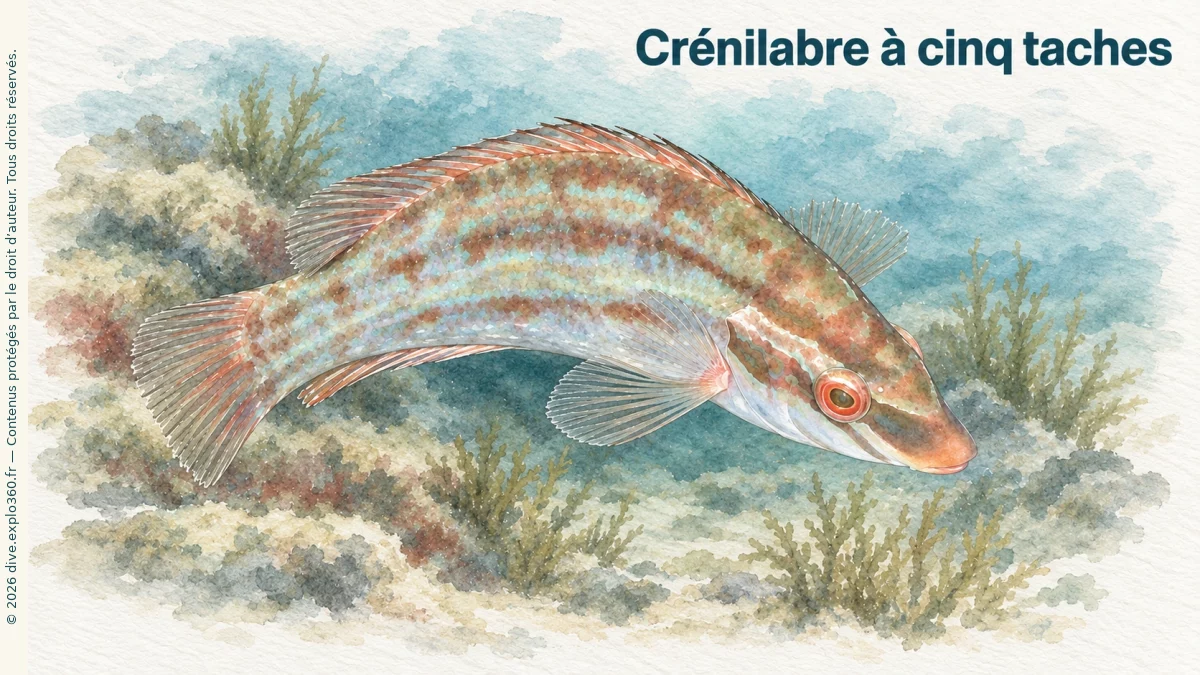
The body is green to brown with dark bands that may be broken. One band crosses the snout between the eyes, and several slanting lines mark the cheeks. The eyes are red.
Mediterranean males reach about 17 centimetres, while females remain smaller. During breeding, males become brighter and patches along the dorsal fin base become more apparent.
Bands and patches may stand out clearly or blend into the body colour. Cheek lines remain a useful clue when flank markings show little contrast.
WHERE DOES IT LIVE?
The species lives on rocky bottoms and in seagrass beds, mainly in the upper ten metres. It can also occur deeper, down to around thirty metres.
In summer it sometimes appears in less than a metre of water. Small rocks close to the shore can therefore provide good opportunities to watch it.
WHAT DOES IT EAT?
It takes small crustaceans, molluscs, sea urchins and hydroids, tiny attached relatives of jellyfish.
Its mouth has small teeth for grasping prey. Meals are linked to animals living on surfaces close to the seabed.
GO FURTHER WITH AMIGANSEAU
Unlock the full profile
Deepen your knowledge with the exclusive chapters and interactive resources included in an AMIGANSEAU licence.
- HOW DOES IT REPRODUCE?
- OUR OBSERVATIONS
- ARTICLE
Also included in the full profile
- Advanced navigation between description, ecological context, observations and behaviour
- Interactive food chain to explore the species’ feeding relationships