Habitat
 Depth
 Group
 Role
WHAT DOES IT LOOK LIKE?
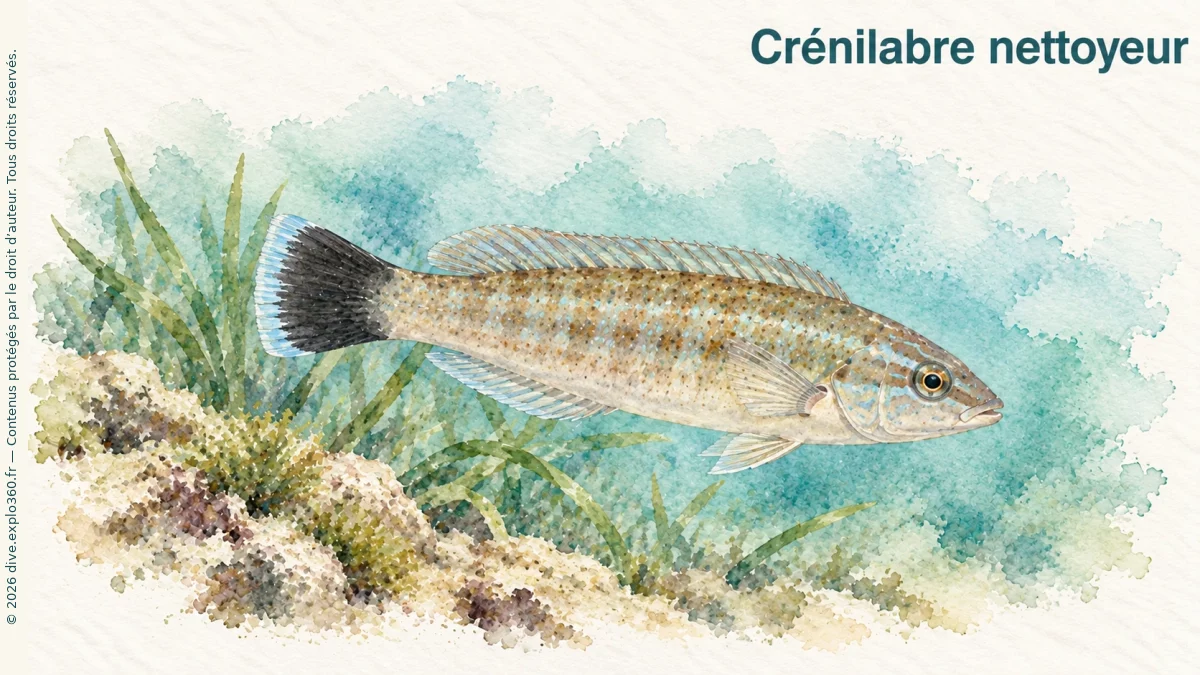
The black-tailed wrasse, formerly Symphodus melanocercus, is a small wrasse reaching about fourteen centimetres in DORIS. Beige colouring carries blue shades that vary with sex and season. The useful tail character is black over its rear two-thirds with a narrow pale, sometimes blue, border. The dorsal fin is continuous. Breeding males may become markedly bluer, limiting the value of colour comparisons alone.
WHERE DOES IT LIVE?
It lives among rocks and seagrass, often where the two meet, down to about 25 m. It moves along walls and among posidonia leaves while feeding. A cleaning spot is one of the places where it stops to interact with other fish.
WHAT DOES IT EAT?
External crustacean parasites provide food during cleaning. Other documented resources include amphipods, copepods, worms, hydroids and bryozoans. Clients adopt different postures, sometimes opening mouths or gill covers. The wrasse gains food; any client benefit depends on what is removed. A still image of neighbouring fish cannot reconstruct the interaction’s duration or result.
GO FURTHER WITH AMIGANSEAU
Unlock the full profile
Deepen your knowledge with the exclusive chapters and interactive resources included in an AMIGANSEAU licence.
- HOW DOES IT REPRODUCE?
- OUR OBSERVATIONS
- ARTICLE
Also included in the full profile
- Advanced navigation between description, ecological context, observations and behaviour
- Interactive food chain to explore the species’ feeding relationships