Habitat
 Depth
 Group
 Role
WHAT DOES IT LOOK LIKE?
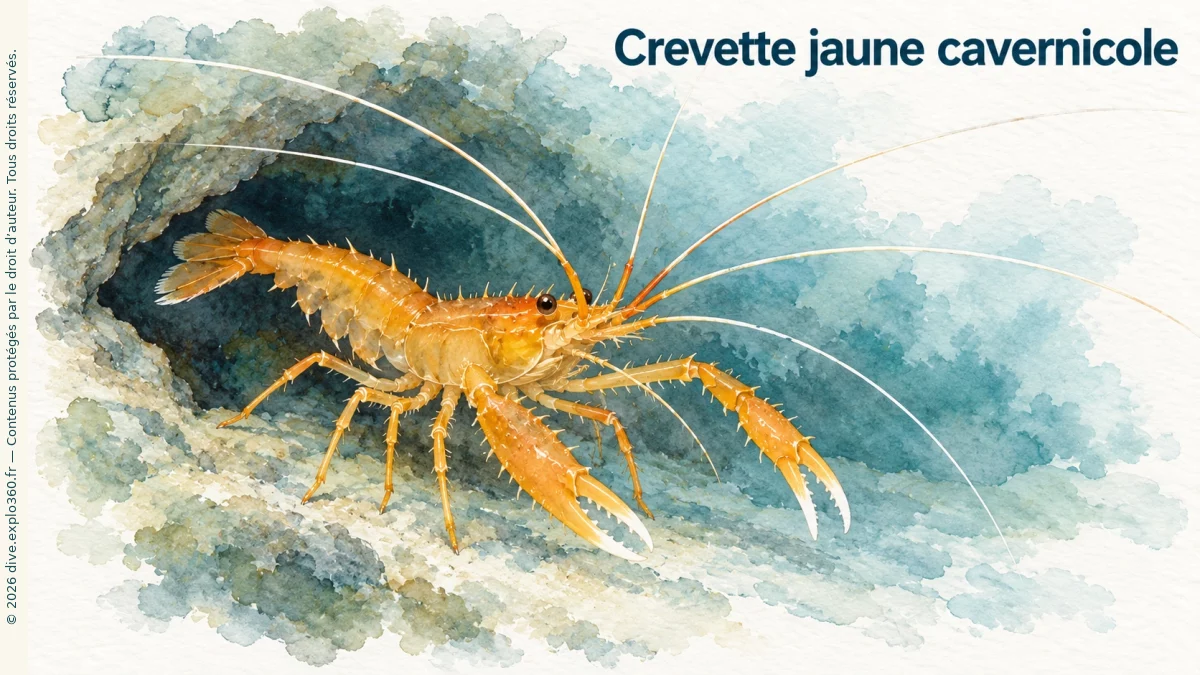
This shrimp can reach around seven and a half centimetres. The yellow to orange, sometimes golden-red body is covered in small forward-pointing spines. The rostrum, the toothed head projection, is straight. Very long antennae are white with orange bases.
The large orange claws with pale tips belong to the third pair of legs. The first two pairs carry much smaller claws. The overall outline differs from transparent prawns or striped Monaco shrimps.
WHERE DOES IT LIVE?
It uses fissures, caves and cavities on hard seabeds, including coralligenous habitats. It may cling to a wall or ceiling rather than walking on a horizontal bottom. At night, it can emerge close to its hiding place.
It lives in the Mediterranean and eastern Atlantic. Although divers mainly see it in accessible rocky refuges, records also exist from great depths. An account limited to diving encounters therefore does not describe its full depth range.
WHAT DOES IT EAT?
Available observations report small animals and food remains in its diet. It can also clean fish. The precise proportions of these resources are less well documented than its appearance.
Observed cleaning and the material consumed need distinguishing: seeing a shrimp pick something from a fish does not always identify a particular parasite. Merely occupying a moray’s hole is not enough to demonstrate feeding either.
GO FURTHER WITH AMIGANSEAU
Unlock the full profile
Deepen your knowledge with the exclusive chapters and interactive resources included in an AMIGANSEAU licence.
- HOW DOES IT REPRODUCE?
- OUR OBSERVATIONS
- ARTICLE
Also included in the full profile
- Advanced navigation between description, ecological context, observations and behaviour
- Interactive food chain to explore the species’ feeding relationships