Habitat
 Depth
 Group
 Role
WHAT DOES IT LOOK LIKE?
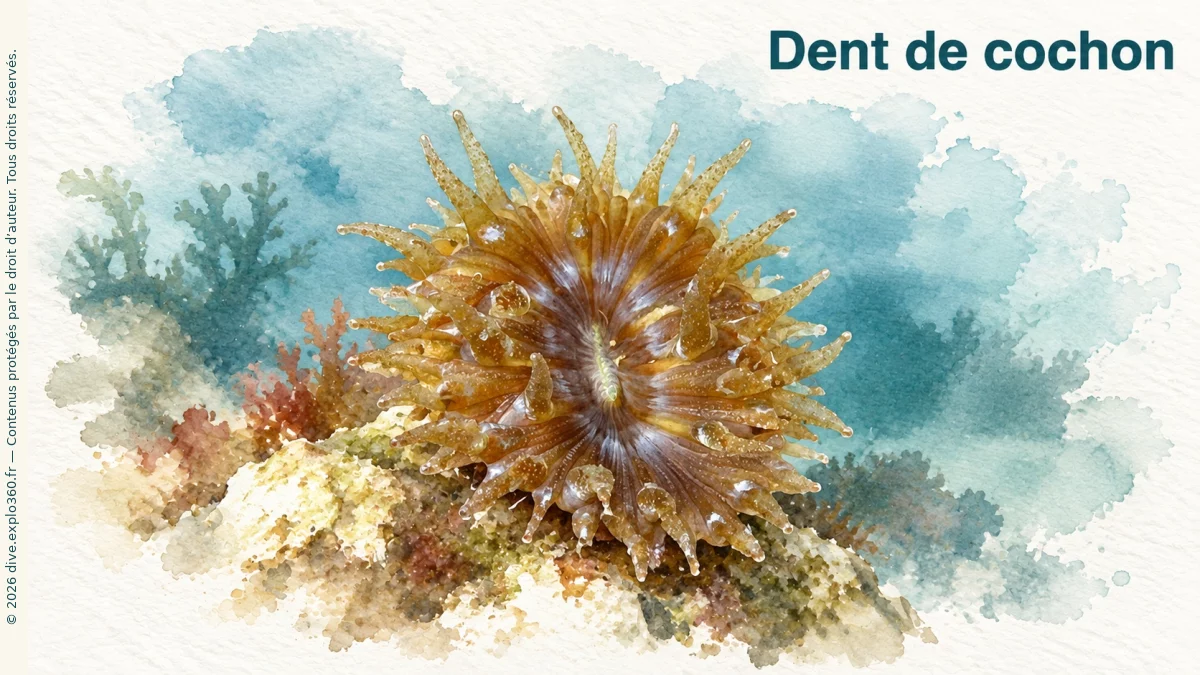
This solitary coral is generally oval and compact. Large individuals can reach three to four centimetres along the longest dimension, with a height around two centimetres. The attached skeleton has internal partitions directed towards the centre.
The polyp, the soft animal, covers this structure and spreads short tentacles around a central mouth. Brownish colour may be tinged with green, red or yellow. A bare skeleton therefore does not show the complete appearance of a living coral.
WHERE DOES IT LIVE?
It grows on rocks, stones and other hard surfaces receiving light. Along French Mediterranean coasts, a careful search of small illuminated surfaces may reveal it. Records extend from shallow water to several tens of metres depending on site.
Distinguish it from solitary yellow corals of shaded places. Light matters because it houses photosynthetic organisms, without explaining every presence or absence on a rock face.
WHAT DOES IT EAT?
Tentacles catch zooplankton, small animals living in the water. Their stinging cells help retain prey, which is then brought to the mouth.
Microscopic algae in the tissues also photosynthesise, using light to make organic matter. Products of this activity contribute to the coral’s resources. Prey capture and association are therefore complementary; concluding that it hardly needs food would be excessive.
GO FURTHER WITH AMIGANSEAU
Unlock the full profile
Deepen your knowledge with the exclusive chapters and interactive resources included in an AMIGANSEAU licence.
- HOW DOES IT REPRODUCE?
- OUR OBSERVATIONS
- ARTICLE
Also included in the full profile
- Advanced navigation between description, ecological context, observations and behaviour
- Interactive food chain to explore the species’ feeding relationships