


 Habitat
 Depth
 Group
 Role
 Average size
WHAT DOES IT LOOK LIKE?
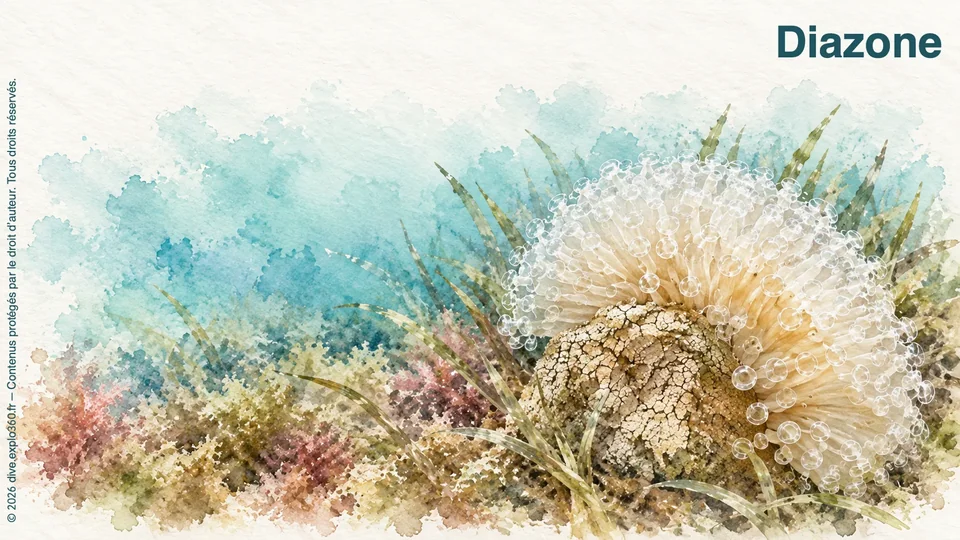
In this sea squirt colony (Diazona violacea), the tightly packed animals share a rounded, jelly-like base. Their upper parts extend separately above it as small cylinders.
The colony is whitish to yellowish, sometimes pale green, with variable transparency. At the top of each individual, the two siphons, the body openings, may be ringed in white. These pale circles can be absent, leaving a less distinctly patterned appearance.
WHERE DOES IT LIVE?
The violet sea squirt colony attaches to hard substrates such as rocks, drop-offs or coralligenous structures. It is generally observed in areas with currents, between around ten and a hundred metres deep, favouring the supply of food particles.
WHAT DOES IT EAT?
The violet sea squirt feeds on plankton and tiny food particles carried by water. Each member of the colony draws water in through one of its two siphons, small openings at the top of its body. Inside, mucus traps the particles, which moving cilia direct towards the mouth. Filtered water leaves through the second siphon. Currents renew the water around the colony and bring more food particles.
GO FURTHER WITH AMIGANSEAU
Unlock the full profile
Deepen your knowledge with the exclusive chapters and interactive resources included in an AMIGANSEAU licence.
- HOW DOES IT REPRODUCE?
- OUR OBSERVATIONS
- ARTICLE
Also included in the full profile
- Advanced navigation between description, ecological context, observations and behaviour
- Interactive food chain to explore the species’ feeding relationships
- Infographic and illustrated summary profile
 Understand the species