Habitat
 Depth
 Group
 Role
WHAT DOES IT LOOK LIKE?
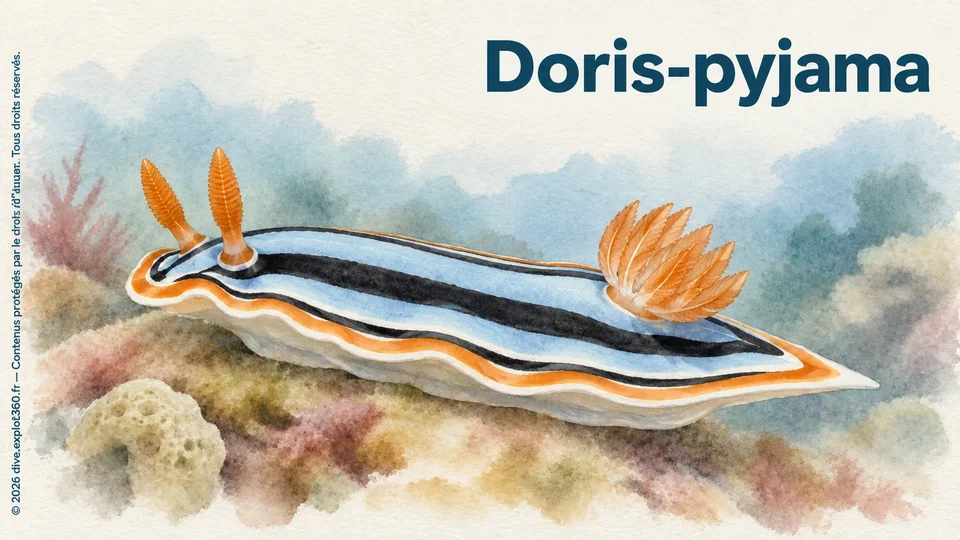
The narrow elongated body reaches about five centimetres. Black stripes alternate with pale-blue areas. A thin white rim lies outside the orange mantle margin. The rhinophores, organs detecting chemical substances, and breathing gills are orange, helping distinguish the animal when several identifying characters are considered together. Body width and borders matter as much as colour because pale blue can be difficult to see in some photographs. Chromodoris africana is broader, with white pale bands and no fine white rim outside the orange margin.
WHERE DOES IT LIVE?
The pyjama nudibranch is native to the Red Sea and western Indian Ocean. It uses reef bottoms and their sponges, often between five and thirty metres. Mediterranean records concern occurrence outside this natural area, not a species naturally endemic to the Mediterranean as a whole. Movement occurs on supports; a suitable food sponge matters more than the presence of a merely colourful surface. New records should retain body and margin details to avoid confusion with other striped Chromodoris species.
WHAT DOES IT EAT?
It consumes particular sponges, including representatives of Negombata and Latrunculia. Its radula, a ribbon bearing tiny teeth within the mouth, removes tissue. A fish or coral nearby is not necessarily a food resource for this nudibranch, even when shown beside it in one photograph. Sponges contain chemical compounds, some of which can be recovered and retained by the nudibranch in the mantle. Prey colour cannot identify a particular sponge; older records may need examination of internal sponge characters.
GO FURTHER WITH AMIGANSEAU
Unlock the full profile
Deepen your knowledge with the exclusive chapters and interactive resources included in an AMIGANSEAU licence.
- HOW DOES IT REPRODUCE?
- OUR OBSERVATIONS
- ARTICLE
Also included in the full profile
- Advanced navigation between description, ecological context, observations and behaviour
- Interactive food chain to explore the species’ feeding relationships