Habitat
 Depth
 Group
 Role
WHAT DOES IT LOOK LIKE?
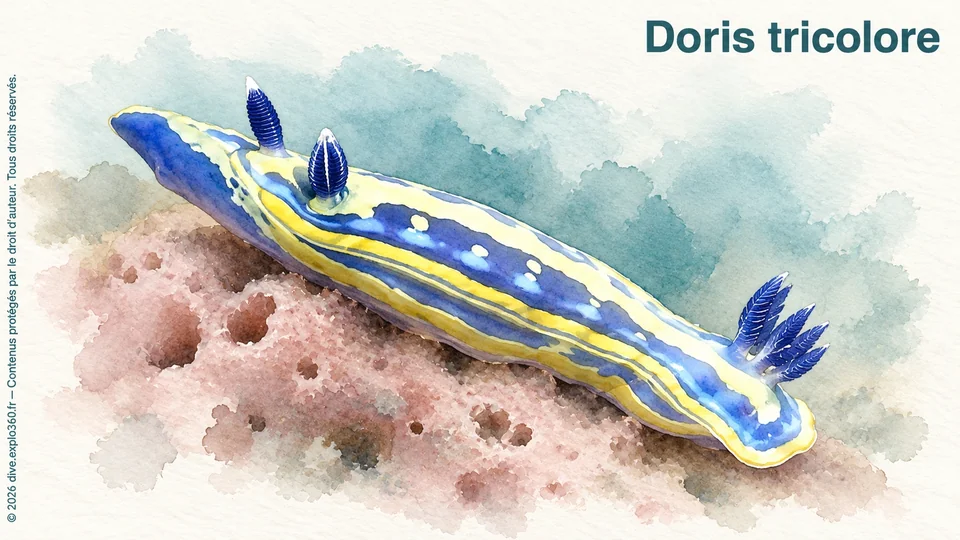
This dorid has a soft, smooth, elongated body, narrower at the rear than at the front. It is usually three to four and a half centimetres long. Against the blue to violet-blue background, a white or yellow band runs from between the head’s sensory organs to beyond the gill plume. Whitish spots may accompany it.
The mantle, the fold covering the back, has a yellow-orange border. A fine pale line follows the sides, sometimes with breaks. The two rhinophores, sensory organs bearing small plates, have whitish tips. The leaflets of the rear gill plume also carry a pale marking.
WHERE DOES IT LIVE?
It inhabits rocky seabeds and other hard surfaces, often in shaded conditions. Records range from about five to sixty metres, notably on sponges. Depth alone therefore does not describe its habitat: the surface and the attached animals growing on it matter too.
It occurs in the western Mediterranean, Adriatic and nearby eastern Atlantic, including areas around the Iberian Peninsula and several neighbouring archipelagos.
WHAT DOES IT EAT?
The tricolour doris eats certain sponges. Reported prey include Dysidea avara and Dysidea fragilis, as well as members of Spongia and Scalarispongia. Tissue is removed with the help of the radula, a ribbon of small teeth inside the mouth.
A sponge is an attached animal that feeds by filtering water. The dorid does not share that feeding method: it consumes the sponge’s tissue. Simply resting on a sponge is not, however, enough to show that feeding is taking place.
GO FURTHER WITH AMIGANSEAU
Unlock the full profile
Deepen your knowledge with the exclusive chapters and interactive resources included in an AMIGANSEAU licence.
- HOW DOES IT REPRODUCE?
- OUR OBSERVATIONS
- ARTICLE
Also included in the full profile
- Advanced navigation between description, ecological context, observations and behaviour
- Interactive food chain to explore the species’ feeding relationships