Habitat
 Depth
 Group
 Role
WHAT DOES IT LOOK LIKE?
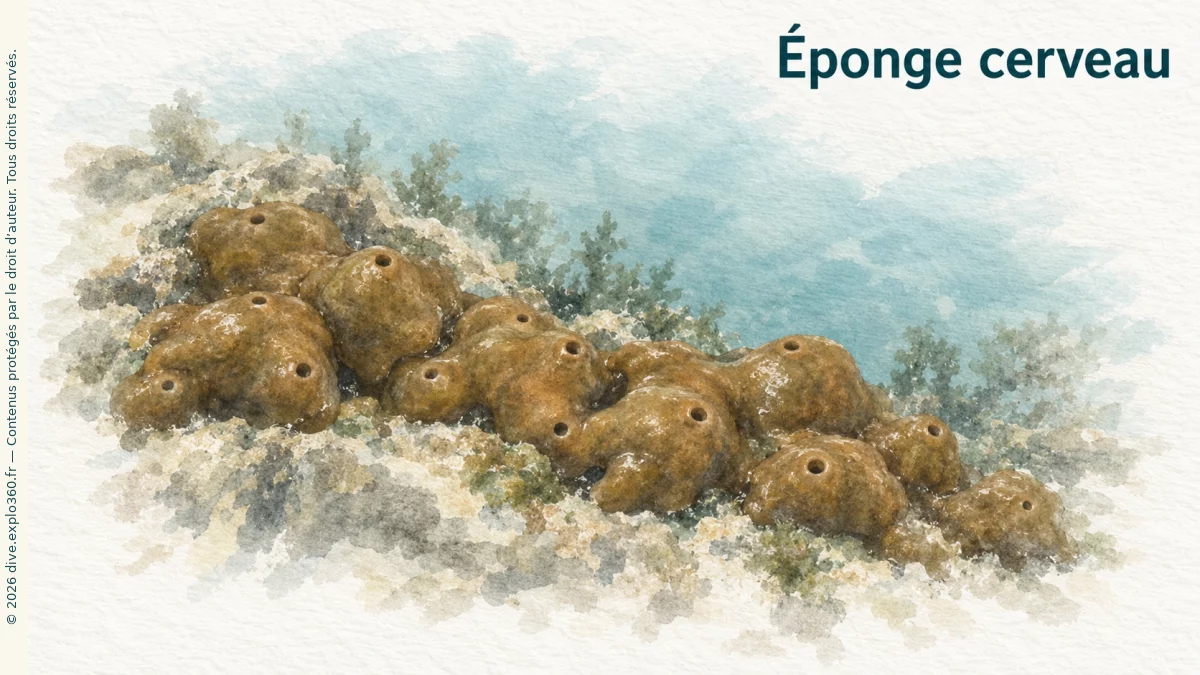
The chicken liver sponge forms rounded cushions a few centimetres across, joined into patches. Their smooth, glossy surface is brown to greenish brown. Reddish shades occur in less illuminated areas. Oscula, the water outlets, are fairly regularly distributed.
The skeleton contains asters, microscopic star-shaped mineral pieces. The cushion pattern explains the French name, “brain sponge”; the animal has no brain.
WHERE DOES IT LIVE?
It occurs on shallow rocks along French Mediterranean coasts and in Posidonia seagrass beds. It often occupies lit, notably horizontal surfaces, but also occurs in hollows and sheltered areas.
Records from the mainland and Corsica document this coastal presence. Colour and form should be considered alongside position: light reaching a boulder’s upper surface differs from light inside a crack.
WHAT DOES IT EAT?
The sponge removes microscopic particles from the water it circulates. Choanocytes, cells with a moving filament and a collar, contribute to pumping and food capture.
It also houses cyanobacteria, bacteria performing photosynthesis: using light to produce organic matter. Their presence in tissues contributes to colour and differs from the temporary arrival of microbes as food.
GO FURTHER WITH AMIGANSEAU
Unlock the full profile
Deepen your knowledge with the exclusive chapters and interactive resources included in an AMIGANSEAU licence.
- HOW DOES IT REPRODUCE?
- OUR OBSERVATIONS
- ARTICLE
Also included in the full profile
- Advanced navigation between description, ecological context, observations and behaviour
- Interactive food chain to explore the species’ feeding relationships